How Moving Companies Get Recommended by ChatGPT, Google and Perplexity
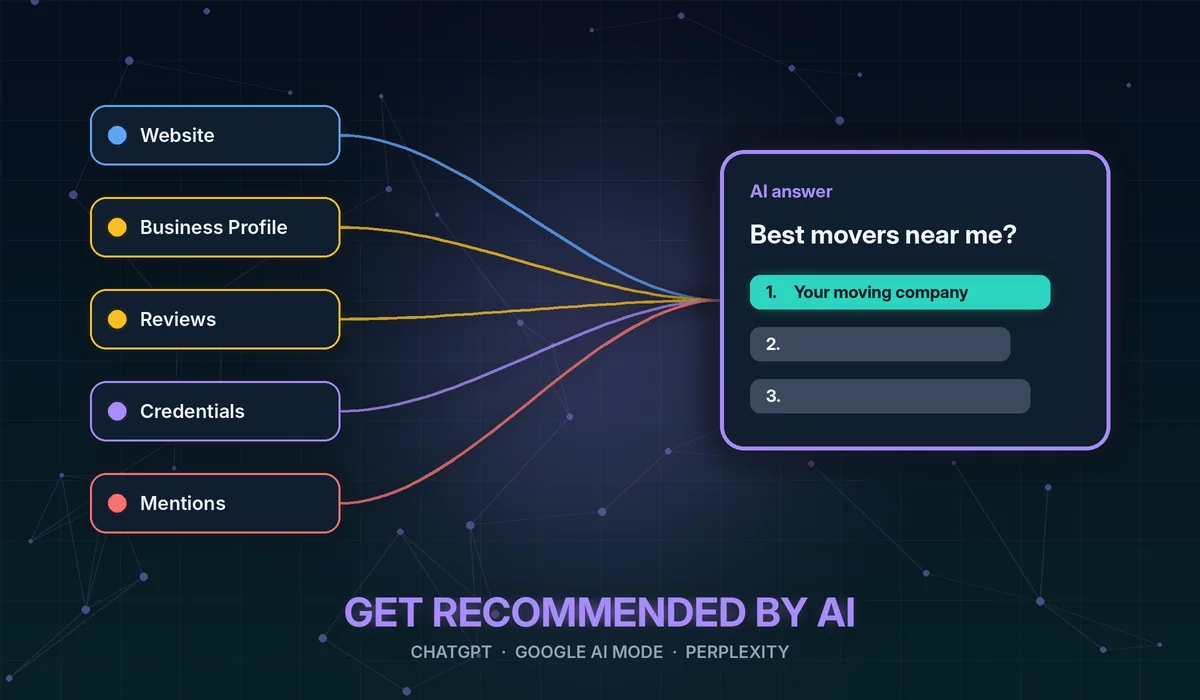
A family planning a move from Miami to Atlanta used to search "long-distance movers," open five tabs and compare star ratings. More of them now type the whole question into an AI assistant and get back a short list of names with reasons attached. By the time they reach a moving company's website, the shortlist is often already made.
This shift is measurable. In BrightLocal's 2026 Local Consumer Review Survey, 45% of US consumers said they used ChatGPT or another generative AI tool for local business recommendations, up from 6% the year before. Google's share of review use fell from 83% to 71% over the same period. For movers, whose customers make one high-stakes hiring decision and worry about damage, delays and surprise charges, being on that AI shortlist is becoming as important as ranking in the map pack.
This guide explains where those AI answers come from, what a moving company can actually control, and how to test your own visibility in about an hour.
What "AI visibility" means for a mover
AI visibility is not a ranking position. An assistant does not show ten blue links; it writes an answer, and your company either appears in it or does not. Three things matter:
- Mentioned: your company is named when someone asks for movers in your area or on your routes.
- Described accurately: the answer gets your service area, interstate status and services right, and repeats what customers actually praise.
- Cited: the answer links to your site, your Business Profile or a page that speaks well of you.
Answers also vary. The same question can produce different names depending on wording, location, the platform and the day. That is why one test search proves very little, and why the testing method later in this guide uses a set of prompts rather than one.
Where AI answers about movers come from
ChatGPT search, Google's AI Overviews and AI Mode, and Perplexity all retrieve live web pages when a question needs current, local information. They then compare and summarize what they find. Two official statements are worth knowing:
- Google says pages need no special files, markup or schema to appear in AI Overviews or AI Mode. A page must be indexed and eligible for a normal search snippet, and Google specifically advises keeping Business Profile information current.
- OpenAI says its OAI-SearchBot crawler is what surfaces websites in ChatGPT search, and recommends allowing it in robots.txt. GPTBot is a separate crawler for model training. Blocking GPTBot does not remove you from ChatGPT search; blocking OAI-SearchBot can.
The sources these systems draw on for a moving question fall into five groups, and a mover can influence every one of them.
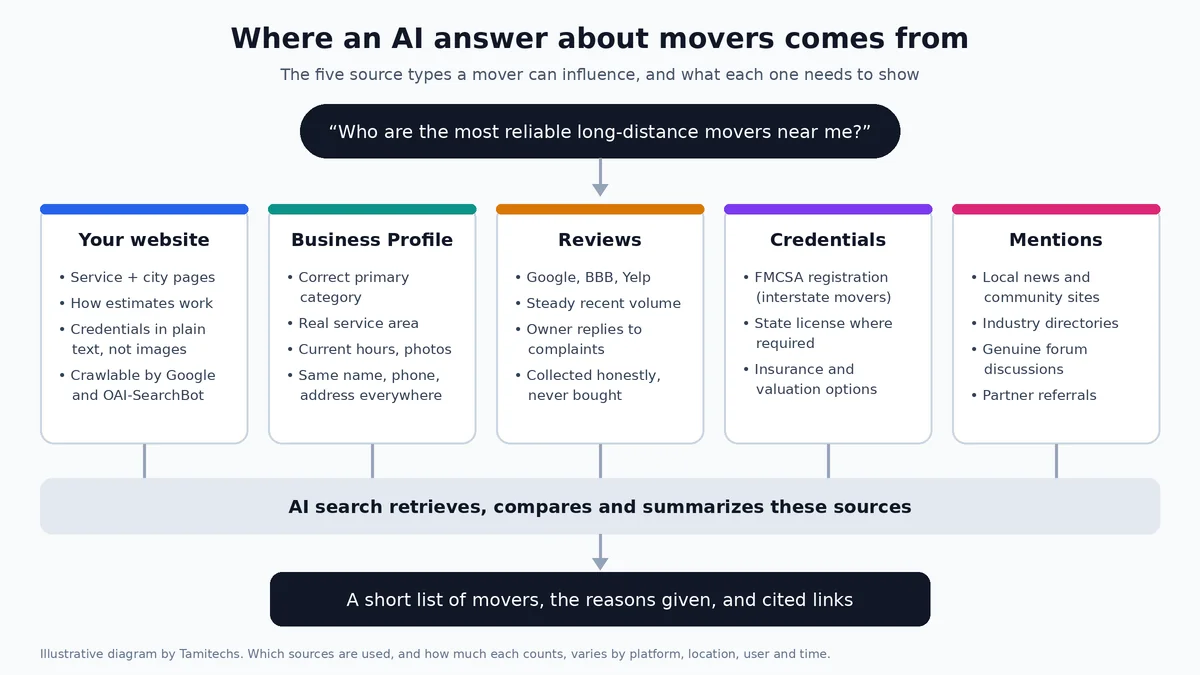
Illustrative diagram by Tamitechs. Which sources are used, and how heavily each counts, varies by platform, location, user and time.
- Your website. The clearest statement of what you do, where, and how pricing works.
- Your Google Business Profile. Category, service area, hours, photos and the reviews attached to it.
- Review platforms. Google, BBB, Yelp and moving-specific sites, including the text of reviews and your replies.
- Credentials and registries. For interstate household goods movers, FMCSA registration, which consumers are told to check on FMCSA's Protect Your Move site.
- Third-party mentions. Local news, community sites, directories, partner pages and genuine forum discussions.
What to fix first
Work through these in order. The early items are cheap and remove reasons for an AI system to skip you; the later ones take months.
- Check that AI crawlers can reach you. Open your robots.txt and confirm Googlebot and OAI-SearchBot are not blocked, then check that your host, CDN or firewall bot settings are not blocking them either. This takes ten minutes and is a common silent failure.
- Make the website specific. Give each core service its own page (local, long-distance, commercial, packing, storage) and each main metro or route its own page with real detail. Explain how estimates work: in-home or virtual survey, binding or non-binding, what changes the price. Put this in plain text, not in images or PDFs.
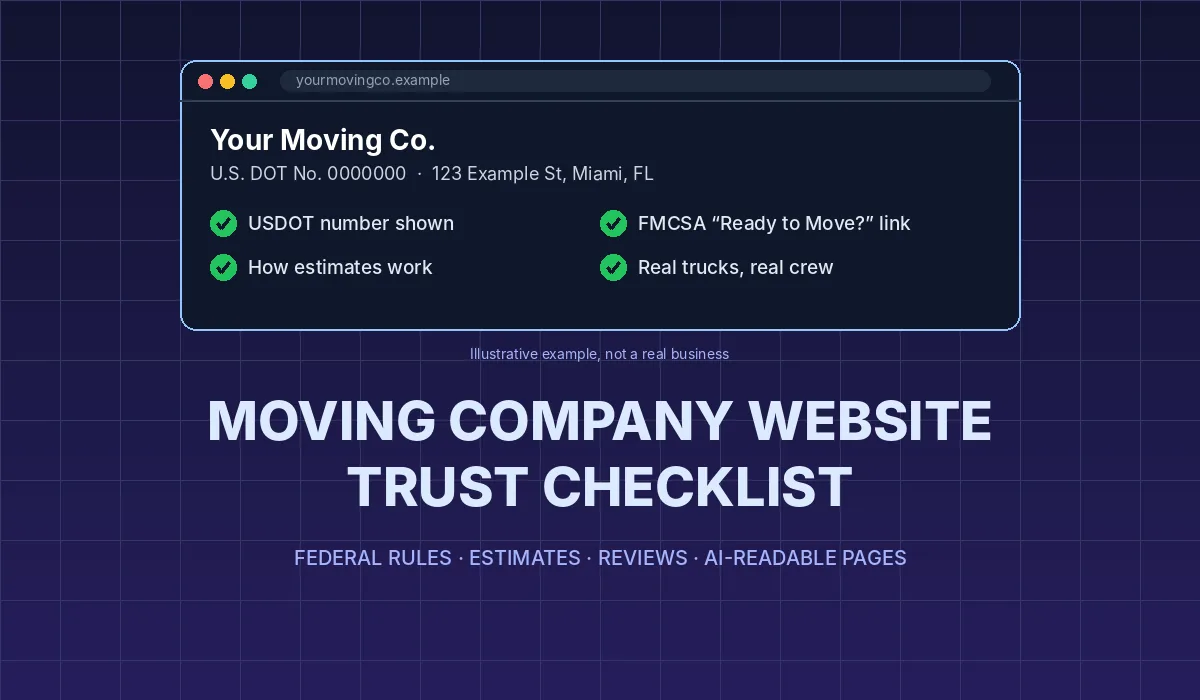
- Publish your credentials as text. Interstate movers should show their USDOT and MC numbers exactly as they appear in FMCSA's registered mover database, plus any state license, insurance and valuation options. Matching, checkable facts make it easier for any system, human or AI, to trust what it reads.
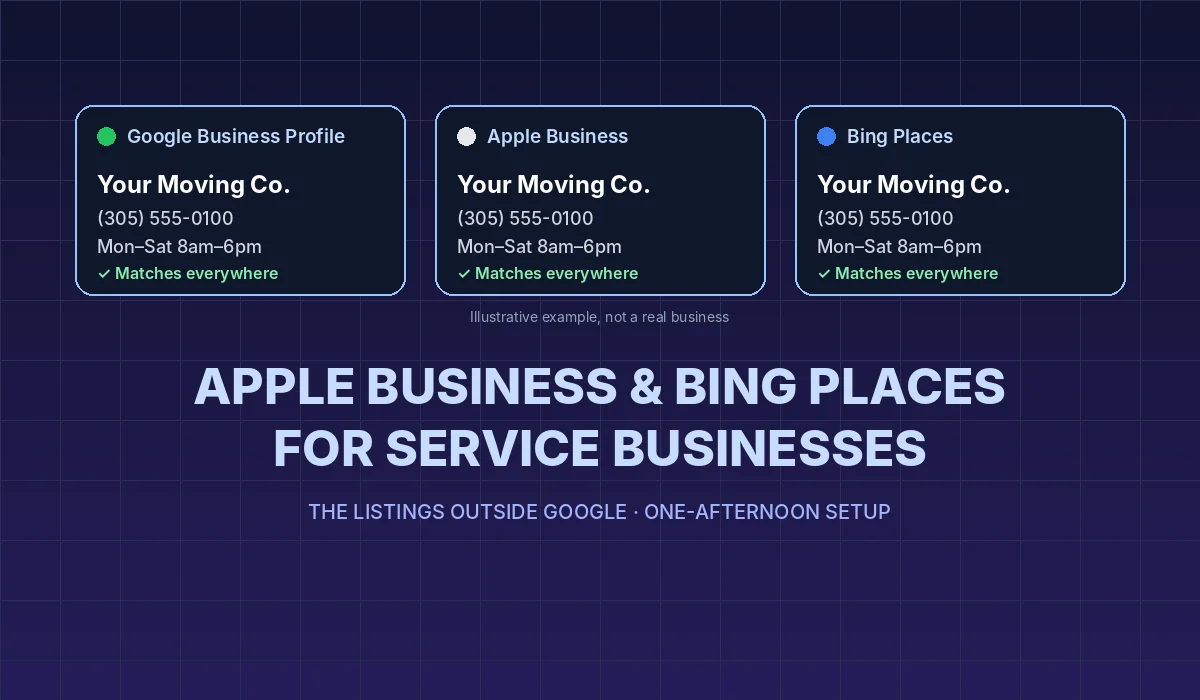
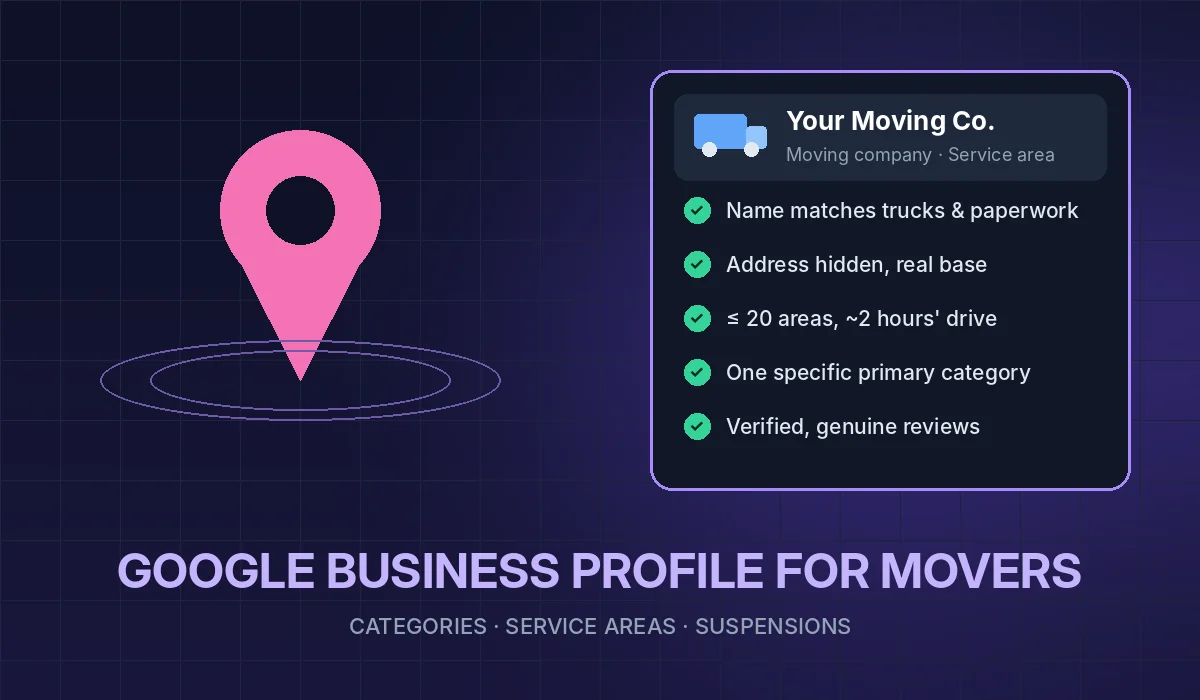
- Clean up your Google Business Profile. Choose the most accurate primary category, set a service area that matches where you actually work, keep hours and photos current, and use the same business name and phone number everywhere.
- Build a steady, honest review flow. BrightLocal's 2026 survey found 31% of consumers will only use a business rated 4.5 stars or higher, 47% won't use one with fewer than 20 reviews, and 82% read AI-generated review summaries. Ask every customer after every job, and reply to every negative review with specifics. Never buy, write or filter reviews: the FTC's 2024 rule bans fake and sentiment-conditioned reviews, and Google removes paid or incentivized ones. A wiped batch of reviews or a suspended profile does far more damage than a 4.3 rating.
- Earn mentions you would be proud of. Local news features, community sponsorships, chamber and association listings, realtor and property-manager partner pages, and genuine answers in local forums under your own name. Paid posts disguised as customer opinions break platform rules and, if discovered, become exactly the kind of story AI summaries repeat.
Test your own visibility in an hour
You don't need software to get a useful baseline.
- Write 10 prompts a real customer would type, with your cities and routes in them: "best long-distance movers from Miami to Atlanta," "affordable local movers in Coral Gables," "are [your company] movers legit," "[your company] reviews."
- Run each prompt in ChatGPT with search on, Google AI Mode, Perplexity and Copilot, in a private or logged-out window.
- Record whether you appear, where you appear in the list, whether the description is accurate, and which sources the answer cites.
- Repeat the same prompts monthly and compare patterns, not single answers.
| Prompt | Platform | Mentioned | Position | Accurate | Sources cited |
|---|---|---|---|---|---|
| best long-distance movers Miami to Atlanta | ChatGPT search | No | – | – | yelp.com, a competitor's site |
| [your company] reviews | Google AI Mode | Yes | 1 | No | bbb.org, Google Maps |
The "sources cited" column is the most useful one. It tells you which sites the AI trusts for your market. If competitors are cited from a directory you are not on, or a brand-name prompt surfaces an old complaint thread, that is your next task, and often a reputation management problem rather than an SEO one.
Measuring what it brings in
Traffic from ChatGPT, Perplexity and Copilot usually shows up in GA4 as referrals from their domains. Google reports AI Overviews and AI Mode clicks inside the normal Web search totals in Search Console, so they cannot be separated there. Phone calls are the bigger blind spot for movers: add "ChatGPT or another AI assistant" as an option when your team asks callers how they heard about you.
No one can guarantee that an AI system will recommend a specific company. What you can do is make sure every source it might read tells the same accurate, verifiable story, and that the story is a good one.
Find out how your moving company shows up today
Tamitechs runs AI visibility audits for moving companies. We test the prompts your customers use across the major AI search tools, show which competitors and sources appear instead of you, and give you a ranked list of fixes across your site, listings and reviews. See what we do for moving companies, or request your AI visibility audit.
Sources
- BrightLocal: Local Consumer Review Survey 2026
- Google Search Central: AI features and your website
- OpenAI: Overview of OpenAI crawlers
- FMCSA: Protect Your Move
- FTC: Final rule banning fake reviews and testimonials
- Google: Maps user contributed content policy
Written by Ava Davis for Tamitechs.