Roofing Leads After a Storm: Business Profile, Local Services Ads and Reviews That Hold Up
When hail or high winds hit a neighborhood, roof searches spike, and so do door knockers, flyers and out-of-town crews. Homeowners know it. Most of them have been warned, by neighbors, news reports or the Federal Trade Commission, to be careful who they hire.
That warning is good news for legitimate roofers. The FTC tells homeowners exactly what to check before they hire anyone. The contractors who win storm-season work are the ones who make those checks easy to pass, in their Google Business Profile, on their website and in their ads. This guide shows how.
What homeowners are told to check
The FTC's consumer advice on hiring after weather emergencies lists the warning signs of a scam, including contractors who:
- claim they don't need a license
- offer a discount only if you sign right away
- tell you to sign over your insurance check
- ask you to pay for everything up front, or to pay by wire transfer, gift card, payment app, cryptocurrency or cash
- ask you to sign a "blank contract"
It also tells homeowners to look up a contractor's reviews online, search their name with words like "scam" or "complaint," confirm their license with the state or county, ask for proof of insurance, get several written estimates and insist on a written contract (Federal Trade Commission).
Read that list as a marketing brief. Every check a homeowner runs is a chance for your business to look trustworthy, or to look like the people they were warned about.
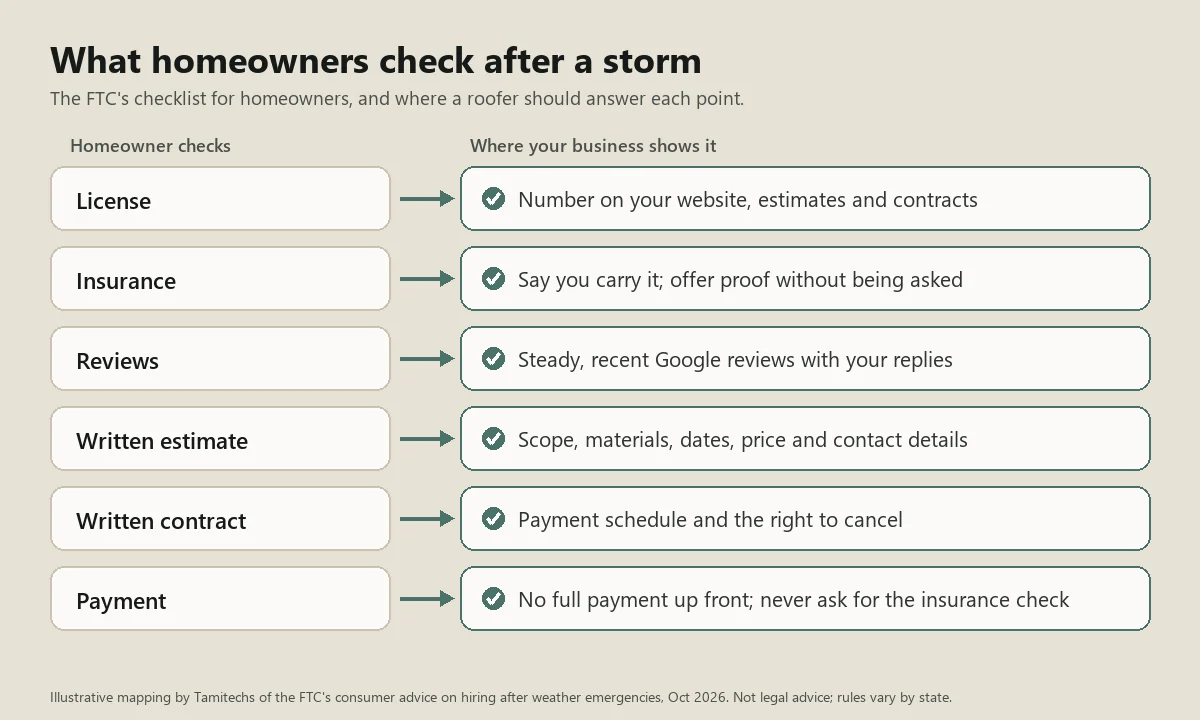
Illustrative mapping by Tamitechs of the FTC's consumer advice cited in this article (October 2026). It is not legal advice; contract rules vary by state.
Your Google Business Profile: one real location
Storm season is when roofers are most tempted to bend Google's rules, usually by creating profiles in the towns that got hit. Don't.
Google's guidelines say service-area businesses "should have one profile for the central office or location with a designated service area," and that they "can't list a 'virtual' office unless that office is staffed during business hours." There should be only one profile per business, and the name should reflect your real-world business name as used on your signs, website and paperwork (Google Business Profile guidelines). Google reserves the right to suspend profiles that break these guidelines, and a suspended profile in the middle of storm season is a very expensive mistake.
What you can do instead:
- Make sure your service area covers the towns you actually serve.
- Post updates with photos of recent storm repairs, with the homeowner's permission.
- Keep your hours accurate, and say so if you're booking inspections days out.
- Reply to every new review, especially during a surge.
Storm landing pages that help instead of hurt
A page about hail or wind damage in your area can be useful, as long as it's honest and specific. Explain what to do in the first 48 hours, how a roof inspection works, what homeowners should photograph for their insurer, and how your estimates and contracts work.
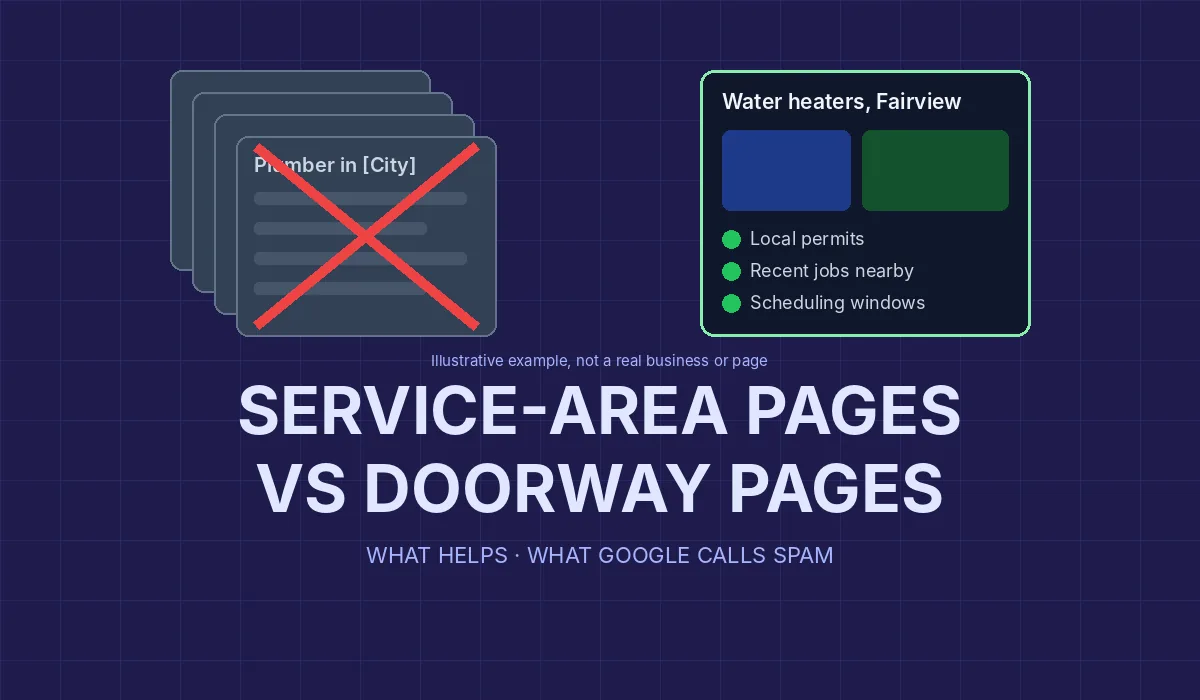
Two things to avoid. First, don't promise what insurance will cover; the FTC tells homeowners not to rely on a contractor to tell them what's covered. Second, don't create a page per town with the same text and a different name. Google's spam policies list "having multiple domain names or pages targeted at specific regions or cities that funnel users to one page" as doorway abuse (Google Search Central). Our guide to service-area pages vs doorway pages explains where the line is.
Local Services Ads: screening that works in your favor
Local Services Ads are Google's lead ads for screened local businesses, and roofing is one of the eligible categories. Google's U.S. requirements for roofing include business and owner background checks, general liability insurance, and state business and owner licenses, for select users. Every Local Services advertiser also needs a public, verified Google Business Profile (Google Local Services Help).
Passing that screening is the online version of what the FTC tells homeowners to check. If you plan to run Local Services Ads during storm season, start the screening well before you need the leads. Our guide to Google Local Services Ads for home service businesses covers how the ads, badges and lead charges work.
Reviews: steady, real and within the rules
Homeowners comparing roofers after a storm will read your recent reviews closely. A steady record of real reviews, with calm replies to the negative ones, is one of the strongest trust signals you have.
The rules are strict:
- Google removes fake engagement, including paid reviews, reviews posted from multiple accounts at one person's request, and "content exhibiting unusual volumes or patterns of review contributions that are indicative of efforts to manipulate a place's rating." Businesses may not "selectively solicit positive reviews from customers" (Google Maps policy).
- The FTC's 2024 rule bans buying reviews, offering incentives for positive (or negative) reviews, and undisclosed reviews from staff or managers (Federal Trade Commission).
The practical answer is a simple habit: ask every customer for a review when the job is finished and the site is cleaned up, with a direct link, whether you think they're happy or not. Real reviews will rise naturally after a busy storm season because you'll have more customers. What you must avoid is anything that looks like manufactured volume.
Make payment and paperwork part of your pitch
Because homeowners are warned about up-front payments and blank contracts, your process is a selling point. Spell it out on your website and in your estimates:
- a written estimate with the scope, materials, start and completion dates, price and your contact details
- a written contract with a payment schedule
- no requests for full payment up front, and no requests for homeowners to sign over insurance checks
- your license number and proof of insurance, offered without being asked
The FTC also suggests homeowners ask their bank about a Certificate of Completion, so the bank pays the contractor in stages after the homeowner approves each one. Being comfortable with that process signals you're not the contractor they were warned about.
Track where storm leads come from
Calls from your Business Profile, direction requests and website clicks all show in Google's performance report, along with the search terms people used to find you (Google Business Profile Help). Compare a storm month with a normal one, and with leads from Local Services Ads, so you know which channel to invest in before the next season.
Before the next storm: a pre-season checklist
Most of this work is easier in a quiet month than in the week after a hailstorm. Before storm season:
- Check that your Business Profile has one real location, an accurate service area and current hours.
- Put your license number and a line about your insurance on your website, estimate template and contract.
- Write or update one honest storm-damage page for your area.
- Start or renew Local Services Ads screening if you plan to run them.
- Set up a review request that goes to every customer when a job is finished.
- Decide who on your team replies to reviews, and how quickly.
- Note your normal monthly calls and leads, so you can measure the storm-season lift.
About this guide
Every rule and figure here was checked against the official pages listed under Sources on October 31, 2026. Platform policies and regulations change, so check the linked pages before you act on them. This is general marketing information, not legal or insurance advice. Contract, licensing and cancellation rules vary by state, so check yours.
Get help with storm-season marketing
Our roofing and exterior contractor marketing service sets up profiles, pages and review processes that hold up when homeowners look closely, our Google Ads management team runs search and Local Services campaigns, and our reputation management team handles review requests and replies. Contact us before the next storm, not after.
Sources
- Federal Trade Commission, How to avoid scams after weather emergencies and natural disasters
- Google Business Profile Help, Guidelines for representing your business on Google
- Google Search Central, Spam policies for Google web search
- Google Local Services Help, Business screening and verification requirements (United States)
- Google Maps User Generated Content Policy, Prohibited and restricted content
- Federal Trade Commission, Final rule banning fake reviews and testimonials (August 2024)
- Google Business Profile Help, Understand your Business Profile performance and insights