Getting Found by Patients: Local SEO, Reviews and AI Search for Therapy Practices
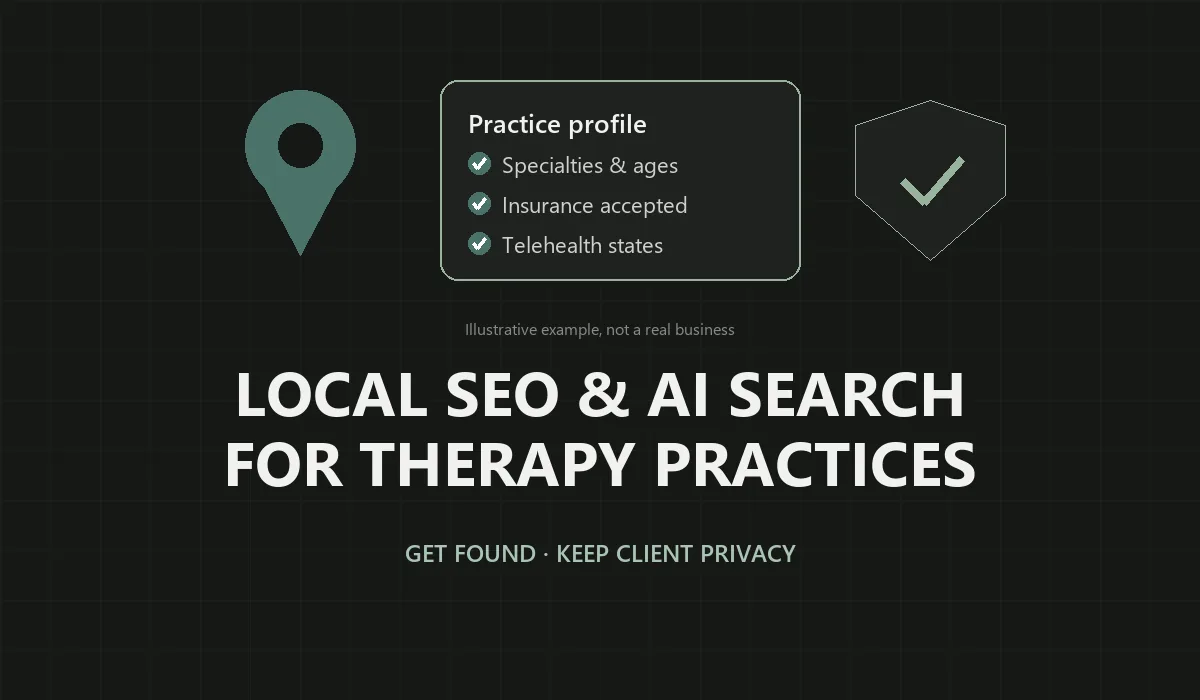
Someone looking for a therapist rarely starts with a directory anymore. They search "therapist near me who takes Aetna," scroll the map, or ask an AI tool "who treats anxiety in teenagers in Austin." The practices that show up are the ones whose information is easy to find, easy to trust and consistent everywhere.
Therapy is also one of the few fields where ordinary marketing advice can get you in real trouble. "Ask happy customers for reviews" and "reply to every review with details" are standard tips for a plumber. For a therapist, they run into privacy law and professional ethics codes. This guide covers how to get found while staying on the right side of both.
How patients find a therapist now
Three places matter most:
- Google Search and Maps, where your Business Profile, website and reviews appear together.
- AI answers, such as Google's AI Overviews and AI Mode or ChatGPT search, which summarize options and link to sources.
- Therapist directories, which often rank for broad searches and are sometimes cited in AI answers.
Google's AI features draw on its normal search index. A page must be indexed and eligible to show with a snippet to appear as a supporting link, and Google tells businesses to keep their Business Profile information up to date (Google Search Central). ChatGPT search relies on OpenAI's crawler, OAI-SearchBot; sites that block it "will not be shown in ChatGPT search answers" (OpenAI).
In practice, that means the basics of local search, a correct profile and a clear website, are also the basics of showing up in AI answers.
Set up Business Profiles the way Google expects
Google has specific rules for practitioners, and therapy practices often get them wrong.
Google defines an individual practitioner as "a public-facing professional, typically with their own customer base," and allows titles or degrees in the profile name. A practitioner should have their own Business Profile only if they work in a public-facing role and "can be contacted directly at the verified location during stated hours." Support staff should not have their own profiles, and "a practitioner shouldn't have multiple Business Profiles to cover all of their specializations" (Google Business Profile guidelines).
For group practices, Google says the organization should have its own profile for the location, separate from each practitioner's, and a practitioner's profile title should include only their name, not the practice name. A solo practitioner who is the only public-facing clinician at a branded practice is better off sharing one profile with the practice.
Two more rules matter for therapists:
- Telehealth-only practices. Google says service-area businesses "can't list a 'virtual' office unless that office is staffed during business hours." If you only see clients by video and nobody works at the address, don't create a profile for a virtual office. Put your effort into your website and directory listings.
- Your real name, nothing extra. Your profile name should reflect your practice's real-world name as used on your signage and website. Google says including unnecessary information in a business name "isn't permitted, and could result in the suspension of your Business Profile," so a name like "Riverside Counseling - Anxiety Therapy Austin" is a risk.
Build a website that answers what patients ask
People choosing a therapist have specific questions, and they often ask AI tools those same questions in full sentences. Your website should answer them clearly, in text:
- Who you see (adults, teens, couples, families) and what you treat
- Your approaches, explained in plain words
- Insurance you accept, and your fees or fee range if you're private pay
- Whether you offer telehealth, and in which states you're licensed
- How soon new clients can usually be seen
- What happens at the first appointment
Google's guidance on helpful content asks whether a page shows "evidence of the expertise involved" and "background about the author or the site that publishes it" (Google Search Central). For a practice, that means real clinician bios with licenses and training, not stock photos and generic copy. Keep your name, address, phone and hours identical on your website, Business Profile and every directory listing.
Reviews: where therapy differs from every other business
Reviews influence both patients and AI summaries. But three sets of rules shape what a practice can do.
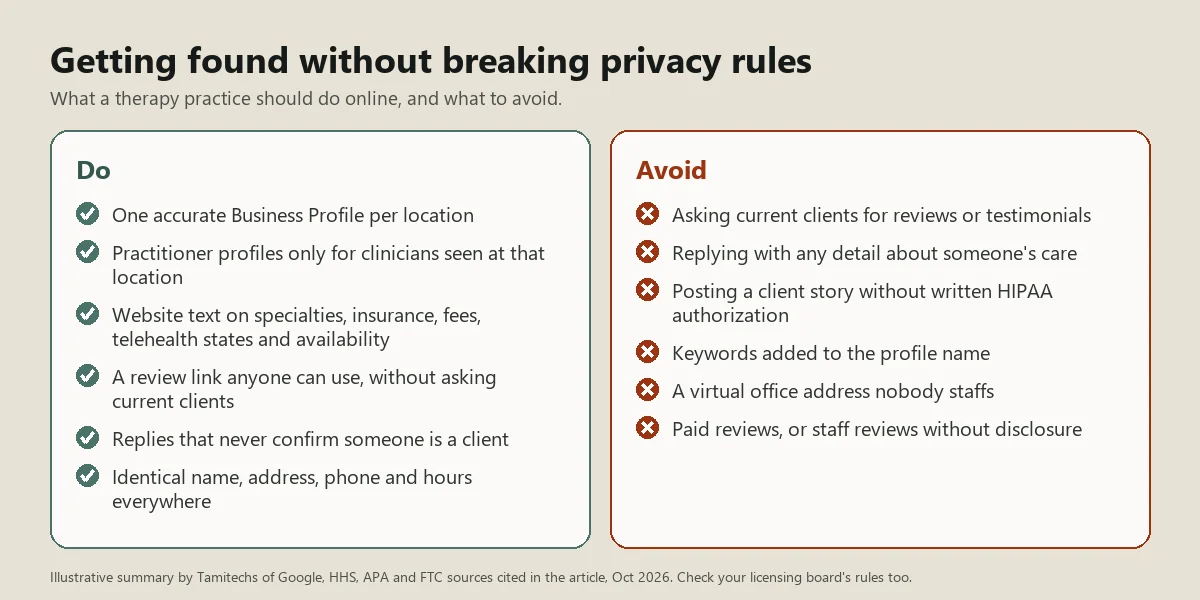
Illustrative summary by Tamitechs of the Google, HHS, APA and FTC sources cited in this article (October 2026). Check your own licensing board's rules too.
Professional ethics codes
The American Psychological Association's Ethics Code is direct: "Psychologists do not solicit testimonials from current therapy clients/patients or other persons who because of their particular circumstances are vulnerable to undue influence" (APA Ethics Code, Standard 5.05). Counselors, social workers and marriage and family therapists have their own codes and state board rules. Check yours before you ask anyone for a review.
What this means in practice: don't send review requests to current clients. Make it easy for people to leave a review on their own, for example with a link on your website, but don't ask them for one.
HIPAA and replying to reviews
Replying to a review can itself be a privacy violation. The HHS Office for Civil Rights settled with Manasa Health Center, a New Jersey psychiatric practice, over responses to negative online reviews that disclosed a patient's protected health information. The practice paid $30,000 and agreed to a corrective action plan (HHS).
Testimonials on your own site carry the same risk. In a 2025 settlement, OCR's director said that "generally, a valid, written HIPAA authorization from an individual is necessary before a covered entity or business associate can post that individual's PHI in a website testimonial or through a social media campaign" (HHS).
A safe reply to any review, positive or negative, never confirms that the reviewer is or was a client. For example:
"Thank you for taking the time to share this. Our policy is not to discuss anyone's care online, and we take all feedback seriously. If you'd like to talk with us, please call the office at [number]."
The FTC's rules on reviews
The FTC's 2024 rule on reviews and testimonials bans fake reviews, buying reviews, and reviews by staff or managers that don't disclose their connection to the business. It also bans using groundless legal threats or intimidation to remove negative reviews (Federal Trade Commission). Google also removes paid or incentivized reviews and content posted from multiple accounts at one person's request (Google Maps policy).
When a review is fake or breaks Google's policy, report it through Google's tools. Our guide to reporting fake Google reviews walks through the process.
Show up in AI answers
AI tools summarize what they can find and verify. For a therapy practice, the most useful steps are:
- Allow the crawlers. Make sure your robots.txt and website host don't block Googlebot or OAI-SearchBot.
- Answer the full question. "Therapist who treats OCD in teenagers and takes Blue Cross in Denver" is a typical AI query. Pages that state your specialties, populations, insurance and location in plain text can match it.
- Keep facts consistent. Conflicting hours, addresses or insurance lists across directories make AI answers hedge or leave you out.
- Show who you are. Named clinicians with credentials, and an About page that explains the practice, give AI tools and patients something to trust.
Our GEO guide covers the full checklist, and our article on tracking AI search traffic in GA4 shows how to see the visits that result.
Track the right numbers
Many patients call straight from your Business Profile without visiting your site. Google's performance report shows calls, direction requests, website clicks and the search terms people used to find you (Google Business Profile Help). Check it monthly along with your website inquiries. If you use call tracking, make sure the provider's privacy terms suit a healthcare setting before you add it.
A checklist for this month
- One accurate Business Profile per location, plus practitioner profiles only for clinicians who meet Google's rules
- No keyword-stuffed profile names and no unstaffed virtual offices
- Website pages that answer who, what, insurance, fees, telehealth and availability
- Clinician bios with licenses and training
- A review reply template that never confirms anyone is a client
- No review requests to current clients, and no testimonials without written authorization
- Identical name, address, phone and hours everywhere
About this guide
Every rule and figure here was checked against the official pages listed under Sources on October 31, 2026. Platform policies and regulations change, so check the linked pages before you act on them. This is general marketing information, not legal, HIPAA compliance or clinical advice. For privacy questions, talk to your compliance advisor, and follow your own licensing board's rules on testimonials and advertising.
Get help with your practice's visibility
Our mental health practice marketing service handles local SEO, AI search visibility and reputation work for therapy practices within these rules, and our reputation management team can take over review monitoring and safe replies. Contact us for a review of how your practice shows up today.
Sources
- Google Search Central, AI features and your website
- Google Search Central, Creating helpful, reliable, people-first content
- OpenAI, Overview of OpenAI crawlers
- Google Business Profile Help, Guidelines for representing your business on Google
- Google Business Profile Help, Understand your Business Profile performance and insights
- American Psychological Association, Ethical Principles of Psychologists and Code of Conduct, Standard 5.05
- HHS Office for Civil Rights, Agreement with Manasa Health Center
- HHS, OCR settles HIPAA investigation of Cadia Healthcare Facilities (September 30, 2025)
- Federal Trade Commission, Final rule banning fake reviews and testimonials (August 2024)
- Google Maps User Generated Content Policy, Prohibited and restricted content