How Law, Accounting and Consulting Firms Get Cited in AI Answers
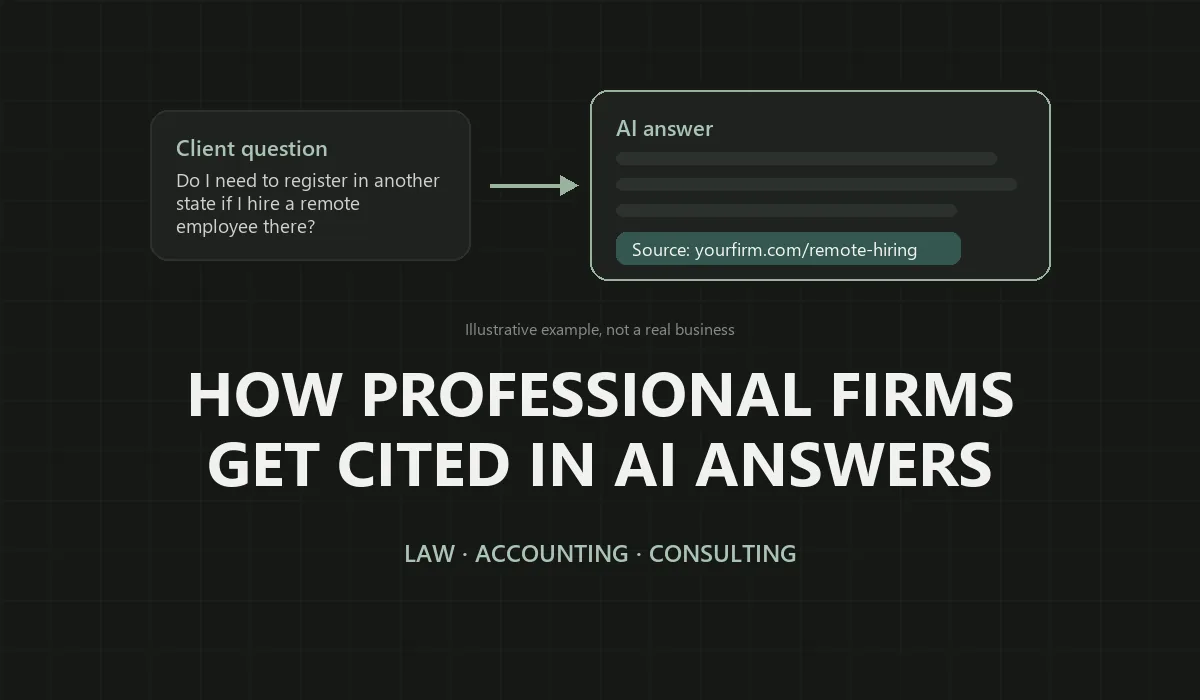
A business owner with a question about a partnership dispute, a new tax rule or an acquisition used to search for a firm and start calling. Now many of them ask an AI tool first: "Do I need to register as an LLC in another state if I hire a remote employee there?" The answer arrives as a summary, with a few sources linked underneath.
For law, accounting and consulting firms, being one of those sources is valuable. It shows expertise at the moment a prospective client is trying to understand their problem. This guide covers how AI answers choose sources, what professional firms should publish, and the rules that shape how firms can describe themselves.
How AI answers find sources
Google's AI Overviews and AI Mode are built on its search index. A page must be indexed and eligible to show with a snippet to appear as a supporting link, and both features may use "query fan-out," running several related searches across subtopics to build a response (Google Search Central). A complex legal or tax question can fan out into searches about definitions, deadlines, thresholds and exceptions. Firms that have clear pages on those subtopics have more chances to be pulled in.
ChatGPT search uses OpenAI's crawler, OAI-SearchBot. Sites that block it "will not be shown in ChatGPT search answers," and site owners can allow it while blocking GPTBot, OpenAI's training crawler (OpenAI). Security plugins and hosting settings can block crawlers without anyone deciding to, so check yours.
The questions themselves are getting longer. Pew Research Center found that just 8% of Google searches with one or two words produced an AI summary, compared with 53% of searches with 10 words or more (Pew Research Center). Professional-services questions are almost always the long kind.
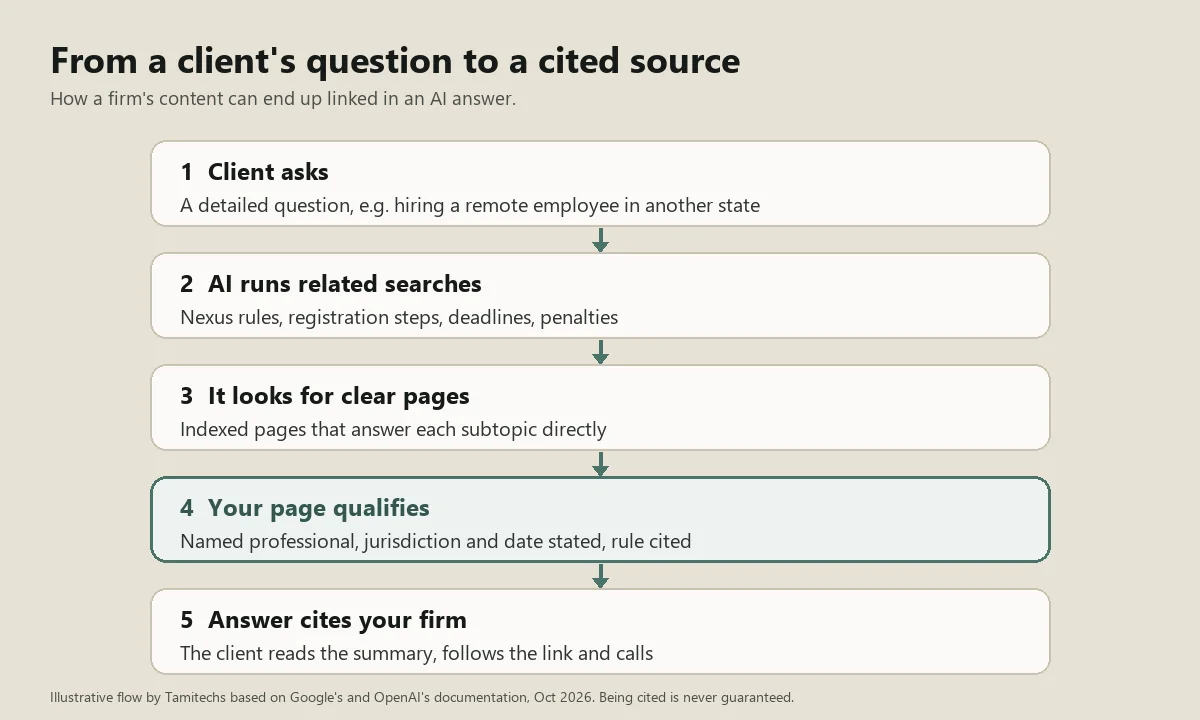
Illustrative flow by Tamitechs based on Google's and OpenAI's documentation cited in this article (October 2026). Being cited is never guaranteed.
What to publish
The firms that show up in AI answers tend to publish one thing well: clear answers to the questions clients actually ask, written by people who know the subject.
Answer real client questions
Start with the questions your professionals answer on the phone every week. Each deserves a page or article that:
- answers the question directly in the first few sentences
- states which jurisdiction or rules it applies to
- explains the main exceptions and when someone should get advice
- shows the date it was written or last reviewed
Google's helpful content guidance asks whether content provides "a substantial, complete, or comprehensive description of the topic" and "insightful analysis or interesting information that is beyond the obvious" (Google Search Central). For a professional firm, "beyond the obvious" usually means the practical detail a generalist article leaves out.
Show who wrote it
The same Google guidance asks whether content shows "evidence of the expertise involved" and "background about the author or the site that publishes it," such as "links to an author page or a site's About page." Put a named attorney, CPA or consultant on every substantive article, link to their bio, and list their credentials and practice areas on that bio.
Keep practice-area pages specific
A page that says "we handle business law" is hard for any system to match to a specific question. Separate pages for your main matters, such as entity formation, partnership disputes or sales tax compliance, with plain explanations of what you do and who you work with, are much easier to understand and cite.
Set up profiles the way Google expects
Google treats lawyers, financial planners and similar professionals as "individual practitioners" and allows titles or degrees such as "JD, Esq., CFA" in their profile names. A practitioner should have their own Business Profile only if they're public-facing and can be contacted at the verified location during stated hours, and should not have multiple profiles for different specialties. Where several practitioners work at one location, the firm should have its own profile separate from theirs, and each practitioner's profile title should contain only their name (Google Business Profile guidelines).
Keep the firm's name, address, phone and hours identical across your website, Google, Apple and Bing listings, and professional directories. Inconsistent details make AI answers hedge or leave you out.
Stay inside the rules on claims
Professional firms face rules that most businesses don't. For lawyers, ABA Model Rule 7.1 says a lawyer "shall not make a false or misleading communication about the lawyer or the lawyer's services," and a communication is misleading if it "omits a fact necessary to make the statement considered as a whole not materially misleading" (American Bar Association). Your state's version of the rules may differ from the ABA model, so check it before you publish claims. Accountants and other licensed professionals have their own codes and state board rules.
In practice:
- avoid unverifiable superlatives like "the best tax firm in Texas"
- present past results with the context your rules require, or not at all
- make sure staff who praise the firm on social media disclose that they work there; the FTC's endorsement guidance covers employees endorsing their own company (Federal Trade Commission)
Accurate, careful content is not just compliant. It's also the kind AI tools are most comfortable quoting.
Reviews and reputation
Reviews feed both prospective clients and AI summaries. The FTC's 2024 rule bans fake reviews, buying reviews, offering incentives for reviews with a particular sentiment, and undisclosed reviews by officers or managers (Federal Trade Commission). Check your professional rules before asking clients for reviews at all, since they vary by profession and state.
When you reply to reviews, don't reveal anything about the client's matter. Confidentiality rules apply online just as they do in the office. Our guide to reputation management in the age of AI covers monitoring and replies in more detail.
Measure what you can
Google says traffic from AI Overviews and AI Mode is included in Search Console's Performance report, under the "Web" search type (Google Search Central). Visits from ChatGPT and other assistants show up in Google Analytics; our guide to tracking AI search traffic in GA4 explains how to separate them and tie them to inquiries.
Once a month, ask Google's AI Mode and ChatGPT the five questions prospective clients ask most often. Note which firms and pages are cited. If competitors keep appearing instead of you, our diagnostic on why ChatGPT recommends your competitor walks through the usual causes.
A checklist for your firm
- Confirm your website allows Googlebot and OAI-SearchBot.
- List your 20 most common client questions and map each to a page.
- Put a named professional, with a linked bio, on every substantive article.
- Add jurisdiction and review dates to anything time-sensitive.
- Set up firm and practitioner profiles according to Google's rules.
- Review every claim on your site against your professional rules.
- Check AI answers for your key questions monthly.
About this guide
Every rule and figure here was checked against the official pages listed under Sources on October 31, 2026. Platform policies and regulations change, so check the linked pages before you act on them. This is general marketing information, not legal, accounting or ethics advice. Professional conduct rules differ by profession and state, so check your bar's or licensing board's rules before you publish claims or ask for reviews.
Get help with your firm's visibility
Our professional services and B2B marketing service builds authority content and AI search visibility for law, accounting and consulting firms, and our SEO team handles the technical side. Contact us for a review of how your firm shows up in AI answers today.
Sources
- Google Search Central, AI features and your website
- Google Search Central, Creating helpful, reliable, people-first content
- OpenAI, Overview of OpenAI crawlers
- Pew Research Center, Google users are less likely to click on links when an AI summary appears in the results (July 22, 2025)
- Google Business Profile Help, Guidelines for representing your business on Google
- American Bar Association, Model Rule 7.1: Communications concerning a lawyer's services
- Federal Trade Commission, FTC's Endorsement Guides: What people are asking
- Federal Trade Commission, Final rule banning fake reviews and testimonials (August 2024)