Why ChatGPT Recommends Your Competitor: A Diagnostic for Local Service Businesses
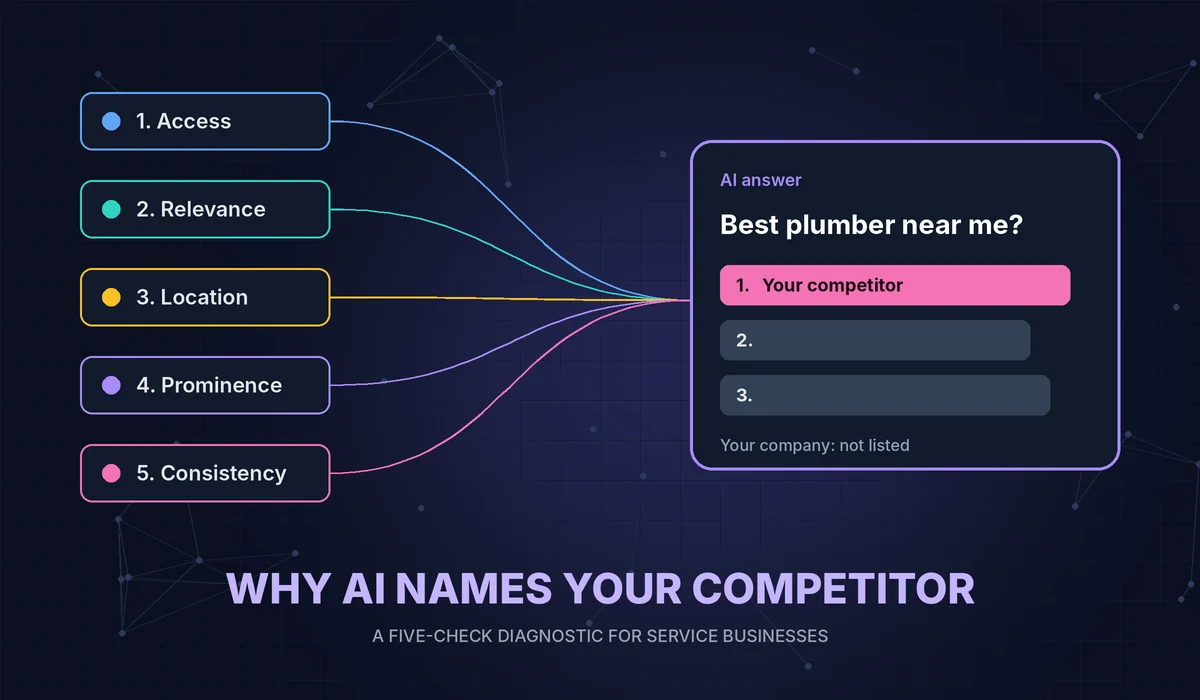
You typed "best water heater repair in Tampa" into ChatGPT, and the first name it gave was the company you bid against every week. You tried again with different wording and got the same competitor, plus two names you have never heard of. Your company did not come up at all.
This happens to plumbers, roofers, movers, HVAC contractors, cleaners and law firms every day, and the usual reaction is to guess: "they must be paying for it" or "AI just likes big companies." Neither is a good working theory. Google states plainly that "there's no way to request or pay for a better local ranking" in its local ranking help page, and OpenAI's help center says ChatGPT search ranks results on multiple factors and that placement is not guaranteed. The reasons a competitor gets named are usually ordinary and checkable.
This article gives you a five-step diagnostic. Each step has a symptom you can see, a cause, and a fix you can start this month.
Step zero: confirm it is a pattern, not one answer
Before you diagnose anything, make sure there is something to diagnose. AI answers move around more than search results do, for three documented reasons:
- They run several searches per question. Google says AI Overviews and AI Mode may use "query fan-out," issuing multiple related searches across subtopics to build one response. Small wording changes can pull in a different set of pages.
- They depend on where the person asking is. OpenAI's help article on searching the web with ChatGPT says ChatGPT may use an approximate location based on IP address to provide local results, and more precise location if the user turns on location sharing. A customer across town can get a different list than you get at your desk.
- They are not always right. The same OpenAI article warns that search results and citations "can be incomplete, outdated, or incorrect."
So run a small, repeatable test instead of one search:
- Write 10 prompts real customers would use: your main services plus your city or neighborhoods ("emergency plumber in Brandon FL," "best roof replacement company near Ybor City"), plus two brand prompts ("is [your company] any good," "[your company] reviews").
- Run each one in ChatGPT with search on, Google AI Mode and Perplexity, in a logged-out or private window.
- Record who is named, in what order, how each company is described, and which websites are cited as sources.
- Repeat weekly for two or three weeks.
If a competitor is named on most service prompts across platforms and you are named on few or none, you have a pattern worth diagnosing. The "sources cited" column will matter more than anything else you record.
The five checks, in order
The order matters. There is no point earning reviews if an AI system cannot read your website, and no point rewriting your website if you are testing from a location you do not serve.
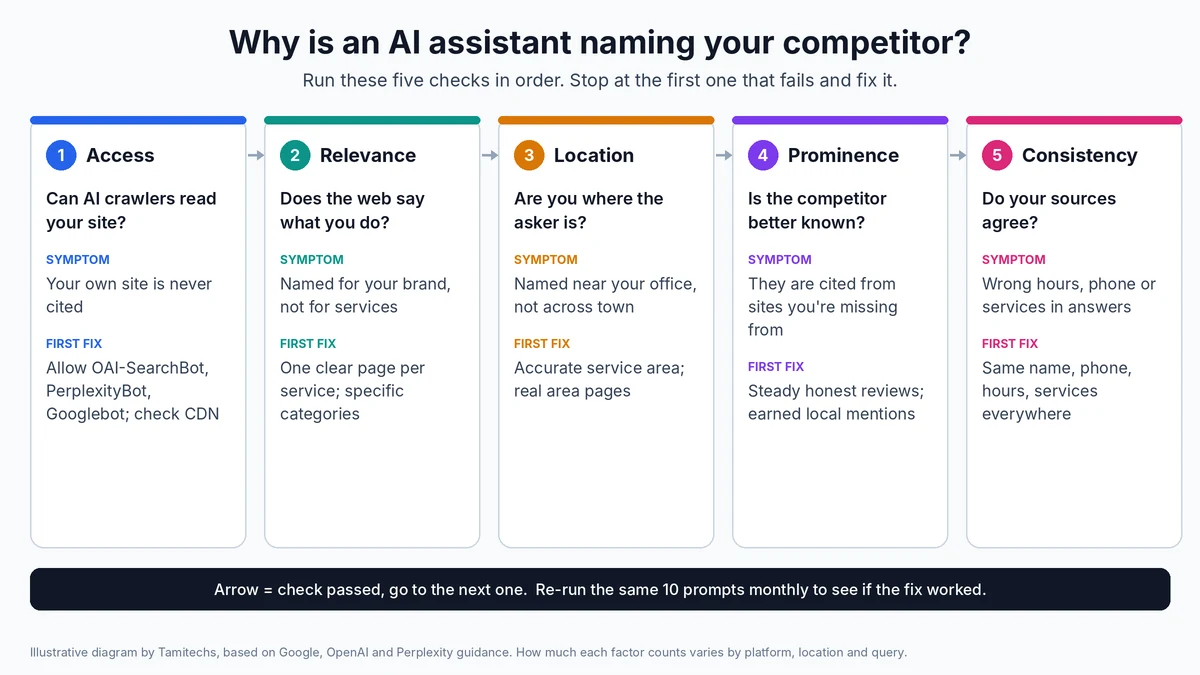
Illustrative diagram by Tamitechs. The checks reflect the published guidance cited in this article; how heavily each factor counts varies by platform, location and query.
1. Access: can the AI systems read your site at all?
Symptom: on brand prompts, the answer says little about you, gets basic facts wrong, or cites only directories and review sites, never your own website.
Why it happens: each AI search product uses its own crawler, and a website can block one without knowing it.
- OpenAI's crawler documentation says OAI-SearchBot is the crawler used "to surface websites in search results in ChatGPT's search features," and recommends allowing it in robots.txt and allowing requests from OpenAI's published IP ranges. It also notes robots.txt changes can take about 24 hours to take effect. GPTBot is a different crawler, used for model training; blocking GPTBot is not the same as blocking search.
- Perplexity's crawler page says PerplexityBot "is designed to surface and link websites in search results on Perplexity" and recommends allowing it.
- For Google, a page must be "indexed and eligible to be shown in Google Search with a snippet" to be used as a supporting link in AI Overviews or AI Mode, per Google's AI features guidance. A stray
nosnippetornoindextag removes that eligibility.
Fix: open yourdomain.com/robots.txt and look for rules that block OAI-SearchBot, PerplexityBot, Googlebot or all bots. Then ask whoever manages your hosting, CDN or firewall whether "bot protection" is blocking them, because that layer often blocks crawlers even when robots.txt allows them. Use Google Search Console's URL Inspection tool on your homepage and main service pages to confirm they are indexed.
2. Relevance: does the web say clearly what you do?
Symptom: you show up for your company name, but not for specific service prompts like "tankless water heater installation," or the AI describes you as doing something you don't do.
Why it happens: Google defines relevance as "how well a Business Profile matches what someone is searching for," and the same logic applies to any system reading your website. If your site has one "Services" page with a bulleted list, and your competitor has a full page for each service explaining what it involves, how pricing works and which areas they cover, the competitor gives an AI system far more to match and quote.
Fix:
- Give each core service its own page, written in plain text (not inside images or PDFs), with the questions customers actually ask: what it costs to diagnose, how long the job takes, what is included.
- In your Google Business Profile, follow Google's guidelines for representing your business: use "as few categories as possible" and choose ones "as specific as possible, but representative of your main business." Keep keywords and city names out of the business name; Google lists marketing taglines and location information as not acceptable there.
- Make sure any structured data on your pages matches what the page visibly says, which Google lists as a best practice. Google also says no special schema, AI text file or markup is needed to appear in its AI features, so don't wait on a technical project before fixing the content.
3. Location: are you actually in the place the answer is for?
Symptom: you appear when you test from your office's neighborhood but not from the suburbs you want to grow into, or the competitor that keeps winning is simply based closer to the customer.
Why it happens: Google lists distance, "how far each business is from the customer who's searching," as one of its three local ranking factors, and ChatGPT uses approximate location for local results. A company 20 minutes closer to the person asking has a real advantage you cannot fully engineer away.
Fix:
- Set your Business Profile's service area to match where you really work. Google's guidelines say a service area "shouldn't extend farther than about 2 hours of driving time from where your business is based," and that service-area businesses should hide their address and keep one profile for the central office.
- Build a page for each area you genuinely serve, with real detail: response times there, typical jobs, local permit or code considerations. A page that only swaps the city name tells a reader nothing new.
- Never create a Business Profile at an address where you don't operate. Google requires a profile for your "actual, real-world location," and suspended profiles disappear from every surface that relies on them.
4. Prominence: is the competitor simply better known?
Symptom: the sources cited for your competitor include review sites, local news, associations or directories where you don't appear, or where you appear with far fewer reviews.
Why it happens: Google defines prominence as "how well-known a business is" and says it is based in part on "how many reviews you have," adding that "more reviews and positive ratings can help your business's local ranking." Customers weigh the same signals. In BrightLocal's 2026 Local Consumer Review Survey of 1,002 US adults, 47% said they won't use a business with fewer than 20 reviews, 31% will only use one rated 4.5 stars or higher, and 74% only care about reviews from the last three months. The same survey found 45% of consumers used AI tools for local business recommendations, up from 6% the year before.
Fix:
- Look at the cited sources from your test. If a competitor is cited from a trade association directory, a local "best of" list or a community news story, ask whether you have a legitimate reason to be there too, and pursue the ones you do.
- Build a steady review flow: ask every customer after every completed job, and reply to every review, especially the critical ones. Recency matters as much as the total.
- Do it honestly. The FTC's 2024 rule on fake reviews bans creating or buying fake reviews, rewarding customers for reviews that express a particular sentiment, and using threats to suppress negative ones, and it allows civil penalties against knowing violators. A purged batch of reviews leaves you worse off than where you started.
If you run a moving company, our guide to getting more Google reviews without breaking Google or FTC rules walks through an ask schedule you can copy.
5. Consistency: do your sources agree about you?
Symptom: the AI names you but hedges ("some customers report…"), quotes an old phone number or hours, describes a service you stopped offering, or surfaces an old complaint as if it were current.
Why it happens: AI answers summarize whatever sources they retrieve. When your website, Business Profile, directory listings and review profiles disagree, the summary inherits the confusion, and a competitor with one clean, consistent story is the easier recommendation. Google's guidelines ask businesses to represent themselves "as it's consistently represented and recognized in the real world," with a phone number "that connects to your individual business location."
Fix: list every place your business appears (website, Google, Bing, Apple Maps, Yelp, BBB, industry directories, social profiles) and make the name, phone, address or service area, hours and services match. Then look at what your brand prompts surface. If an unresolved complaint keeps appearing, reply to it publicly with specifics and resolve it if you can; that is often a reputation management job rather than an SEO one.
Symptom finder
If you only have five minutes, match what you saw in your test to the most likely cause.
| What you see | Most likely cause | Where to look first |
|---|---|---|
| Your own site is never cited, even for your name | Access | robots.txt, CDN or firewall bot settings, URL Inspection |
| Named for your brand, not for services | Relevance | Service pages, Business Profile categories |
| Named near your office, not across town | Location | Service area settings, area pages |
| Competitor cited from sites you're missing from | Prominence | Review counts and recency, directories, local press |
| Wrong hours, phone or services in the answer | Consistency | Listings audit across every platform |
| Different names every time you ask | Not a pattern yet | Run the 10-prompt test for two more weeks |
How to tell whether the fixes are working
Rerun the same prompt set every month from the same locations and compare the trend, not any single answer. Google says clicks from AI Overviews and AI Mode are counted in Search Console's Performance report under the "Web" search type, so they show up in your normal Search Console totals rather than as a separate line. For phone-driven businesses, add "ChatGPT or another AI assistant" to the list of answers your team records when they ask callers how they found you.
Expect access and consistency fixes to show up first, because they remove reasons to skip you. Relevance takes a few crawl cycles. Prominence takes months, and that is also why it is the hardest advantage for a competitor to take away from you once you have it. No one can guarantee that an AI system will name a particular company, and anyone who promises that is guessing.
See where you stand today
Want a quick read on whether AI assistants would recommend you? Run the free AI Recommendation Stress Test on our homepage. If the answer is "not yet," Tamitechs runs AI visibility audits for US service businesses: we test the prompts your customers use, show which competitors and sources appear instead of you, and hand you a ranked fix list across your site, listings and reviews. See our AI SEO services or tell us about your business.
Sources
- Google Business Profile Help: Tips to improve your local ranking on Google
- Google Business Profile Help: Guidelines for representing your business on Google
- Google Search Central: AI features and your website
- OpenAI Help Center: Searching the web with ChatGPT
- OpenAI: Overview of OpenAI crawlers
- Perplexity: Perplexity crawlers
- BrightLocal: Local Consumer Review Survey 2026
- FTC: Final rule banning fake reviews and testimonials (August 14, 2024)
Written by Ava Davis for Tamitechs.