How to Get More Google Reviews for a Moving Company (Without Breaking Google or FTC Rules)
Most moving companies don't have a review problem. They have an asking problem. Crews finish the job, the customer is relieved, everyone shakes hands, and nobody sends the link. Three weeks later, the only person motivated enough to write a review is the one whose dresser got scratched.
The fix is a simple system: ask every customer, at the right moment, in the same way, with nothing attached. This guide covers why volume and recency matter for movers, the rules that can get reviews removed or a business penalized, and a step-by-step process you can start this week.
Why the number and age of your reviews matter
BrightLocal's 2026 Local Consumer Review Survey shows how customers judge a review profile:
- 47% won't use a business with fewer than 20 reviews.
- 31% will only use a business rated 4.5 stars or higher, up from 17% the year before.
- 74% look for reviews from the last three months, and 32% want reviews from the last two weeks.
- 78% were asked to write a review in the last 12 months, so asking is normal and expected.
For a mover, the takeaway is that a steady trickle beats an occasional burst. Twenty new reviews spread across the year look more trustworthy, and more current, than twenty posted the week after a push.
The rules: what's allowed and what isn't
Three sets of rules matter, and they don't all say the same thing.
| Practice | FTC rule | Yelp | |
|---|---|---|---|
| Asking every customer for a review | Allowed | Allowed | Not allowed |
| Sharing a review link or QR code | Allowed | Allowed | Not allowed |
| Discounts, gifts or refunds for reviews | Prohibited | Prohibited if tied to positive or negative sentiment | Prohibited |
| Asking only happy customers | Prohibited | Not addressed directly; suppressing negative reviews by threats is banned | Not allowed (no asking at all) |
| Reviews from employees or relatives | Prohibited | Restricted, must disclose | Not allowed |
| Staff review quotas | Prohibited | Not addressed | Not allowed |
| Asking for specific wording or stars | Prohibited | Not addressed | Not allowed |
Google. Its help pages encourage businesses to ask for reviews by sharing a link or QR code, and say offering free or discounted goods or services in exchange for posting, changing or removing reviews is "strictly prohibited" (Google: review link and QR code). The Google Maps contribution policy adds that businesses may not discourage negative reviews or selectively ask for positive ones. When asking, they shouldn't pressure customers to post on the premises, set staff quotas, or request specific content. Reviews from employees or people with family ties count as conflicts of interest.
The FTC. The FTC's 2024 rule bans fake reviews and incentives conditioned on positive or negative sentiment. It also bans suppressing negative reviews through threats or intimidation and requires insiders to disclose their connection. The FTC can seek civil penalties against knowing violators.
Yelp. Yelp asks businesses not to ask anyone for reviews at all, and says its software may not recommend reviews that seem prompted, so asking can hurt your rating (Yelp: don't ask for reviews). Keep Yelp out of your review requests entirely.
Step 1: Create your Google review link and QR code
Google gives every verified Business Profile a direct review link:
- Go to your Business Profile at business.google.com.
- Select Read reviews, then Get more reviews.
- Copy the link, or save the QR code. Google notes the QR code can only be generated in a computer browser, not on a phone.
Google suggests sharing it on receipts, in thank-you emails, at the end of a chat, or by email, WhatsApp or a Facebook post (Google Business Profile Help). Reviewers need a Google account.
For a mover, the most useful places are the job-completion text or email, the final invoice, and a printed QR code on the paperwork your crew leaves behind.
Step 2: Ask at the right moment
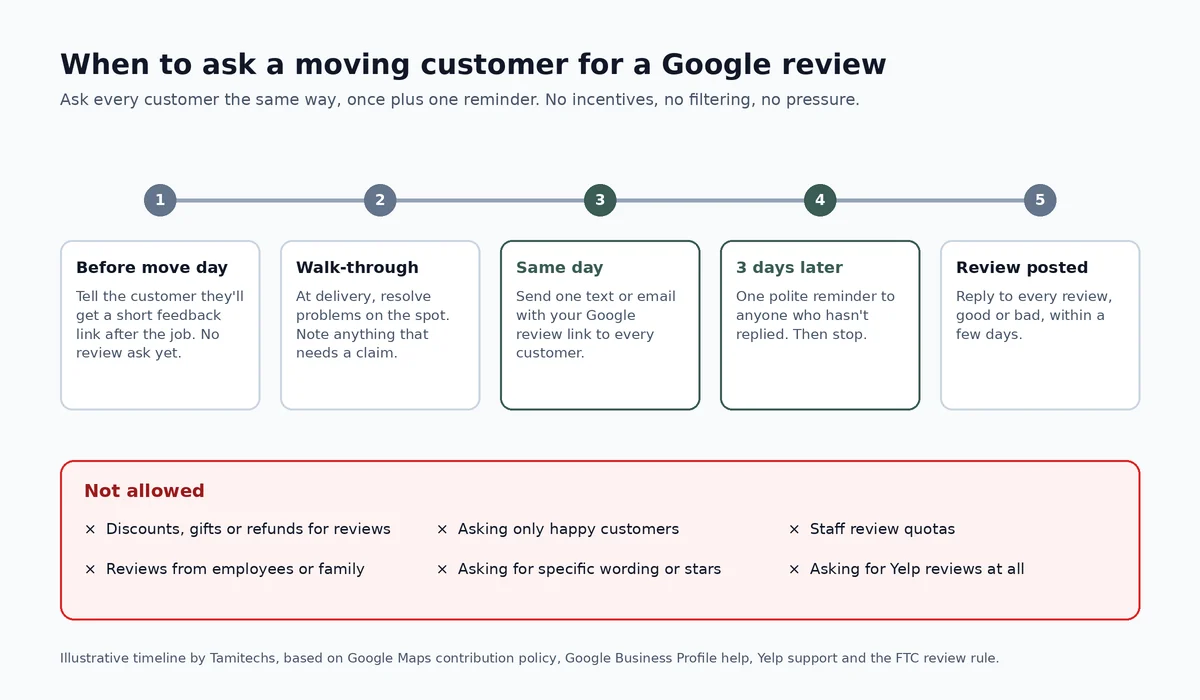
Illustrative timeline by Tamitechs, based on Google's and Yelp's policies and the FTC rule.
The best moment for a mover is the same day the job ends, after the delivery walk-through. The customer has just seen everything arrive, and any problems have either been fixed or written up for a claim.
- Before move day: mention in your confirmation that you'll send a short feedback link afterward. This isn't the review request yet.
- At the walk-through: resolve what you can on the spot and write up anything that needs a claim. Don't hand the customer a tablet and ask for a review at the door. Google specifically says not to pressure customers to post on the premises.
- Same day: send one text or email with your Google review link to every customer, including the ones whose move had problems.
- Three days later: one polite reminder to anyone who hasn't left a review. Then stop.
- When a review comes in: reply. BrightLocal found 89% of consumers expect owners to respond, and 80% are likely to use a business that responds to all its reviews.
Step 3: Say it simply
A short, plain request works better than a long one. Ask for honest feedback, not five stars. For example:
Hi Maria, thanks for choosing us for your move to Tampa today. If you have a minute, we'd appreciate an honest review of how it went: [your Google review link]. If anything wasn't right, reply to this message and the office will call you. — Daniel, Ocean Movers
What makes this request rule-safe:
- It goes to every customer, not just the happy ones.
- It asks for an honest review, not a rating or particular wording.
- It offers nothing in exchange.
- It gives unhappy customers a direct line to fix things, without steering them away from the review link.
That last point matters. Giving customers a way to reach you is good service. Sending the review link only to customers who answered a survey positively is review gating, and Google's policy prohibits selectively soliciting positive reviews.
Step 4: Keep your crews out of the numbers
It's tempting to reward crews for review counts. Google's policy bans staff review quotas, and the incentive tends to push crews toward asking only the customers they think are happy. Reward what customers say instead: share reviews that mention crew members by name at your weekly meeting, and use complaint patterns to target training.
Never let employees, their families or friends post reviews of your company. Google treats them as conflicts of interest and removes them, and the FTC rule restricts insider reviews.
Step 5: Watch for the problems that wipe out reviews
Reviews that break Google's rules can be removed, and a batch of removed reviews can do more damage than the original problem. Patterns that look suspicious to customers and platforms alike include:
- A sudden burst of reviews after months of silence
- Reviews from accounts with no other activity
- Several reviews with similar wording
- Reviews posted from your office network or on your devices
- Any review connected to a discount, gift card, refund or "thank-you" offer
If a competitor or someone who never hired you posts a fake review, report it through your Business Profile or Google's Reviews Management Tool. Google says review evaluation typically takes several days, and you get one appeal if it finds no violation (Google: report inappropriate reviews). Report only genuine violations, since Google says not to report a review just because you dislike it.
What a healthy review flow looks like
You don't need a huge number. You need a steady one. If you complete 40 jobs a month and ask every customer, a reasonable target is a few new reviews every week, every review answered within a few days, and no gaps of more than a couple of weeks without a new review. Those numbers line up with what BrightLocal says customers look for: recent reviews, consistent sentiment and visible replies.
Review flow also feeds AI search. AI assistants summarize what review platforms say about you, so a profile with recent, varied, answered reviews gives them better material. We explain how that works in How Moving Companies Get Recommended by ChatGPT, Google and Perplexity.
Get help setting up your review system
Tamitechs sets up review systems for moving companies: review links and QR codes, request templates, reply workflows, and review bundles for the platforms your customers check. See our reputation management service and what we do for moving companies, or message us about review bundles.
Sources
- BrightLocal: Local Consumer Review Survey 2026
- Google Business Profile Help: Create a review link or QR code
- Google Business Profile Help: Tips to get more Google reviews
- Google Business Profile Help: Report inappropriate reviews
- Google Maps: Prohibited and restricted content
- FTC: Final rule banning fake reviews and testimonials
- Yelp Support: Don't ask for reviews
Written by Ava Davis for Tamitechs.