
Generative Engine Optimization (GEO): The 2026 Guide for Service Businesses

"Generative engine optimization," or GEO, is the name the marketing world settled on for a simple goal: getting your business mentioned and linked when someone asks an AI tool a question. That might be Google's AI Overviews or AI Mode, ChatGPT search, Microsoft Copilot or Perplexity.
There's a lot of noise around GEO. Some agencies say traditional SEO is dead and sell special "AI files" or schema tricks. Others say nothing has changed. The truth is in between, and the platforms themselves have been fairly clear about it. This guide pulls together what they say, what it means for a service business, and a checklist you can work through.
What GEO is, and what it isn't
GEO is not a separate system that replaces SEO. Google says it directly: "The best practices for SEO remain relevant for AI features in Google Search," and "There are no additional requirements to appear in AI Overviews or AI Mode, nor other special optimizations necessary" (Google Search Central).
What has changed is how answers are presented and how people use them:
- Answers come first, links second. An AI summary often answers the question before the user sees a list of websites. Your goal is to be one of the sources the answer is built from and links to.
- More of the journey happens without a click. Pew Research Center found that Google users clicked a traditional result in 8% of visits when an AI summary appeared, versus 15% without one (Pew Research Center). Our article on zero-click searches covers what that means for revenue.
- Questions are longer and more specific. In the same Pew study, only 8% of one- or two-word searches produced an AI summary, but 53% of searches with 10 or more words did. People ask AI tools full questions, like "who installs heat pumps in Tampa and offers financing," not two-word keywords.
So GEO is best understood as SEO for a world of longer questions and summarized answers. The fundamentals carry over; the emphasis shifts.
How AI answers choose their sources
Google AI Overviews and AI Mode
Google's AI features are built on its search index. To be shown as a supporting link, "a page must be indexed and eligible to be shown in Google Search with a snippet." Both features "may use a 'query fan-out' technique — issuing multiple related searches across subtopics and data sources — to develop a response" (Google Search Central).
Query fan-out is the key idea for service businesses. A question like "should I repair or replace my 12-year-old furnace" may trigger related searches about furnace lifespan, repair costs, efficiency ratings and local rebates. A site that covers the subtopics around a job has more chances to be pulled in than a site with one thin service page.
ChatGPT search
ChatGPT finds websites through OpenAI's search crawler. OpenAI says "OAI-SearchBot is used to surface websites in search results in ChatGPT's search features," and that sites that block it "will not be shown in ChatGPT search answers." Site owners can allow OAI-SearchBot while blocking GPTBot, OpenAI's training crawler, so appearing in search doesn't require letting your content be used for training (OpenAI).
Discussion and reference sites
AI answers lean heavily on a few kinds of sources. In Pew's study, Wikipedia, YouTube and Reddit were the most frequently cited sources in Google's AI summaries, and government sites made up 6% of AI summary sources compared with 2% of standard results. For a local business, that means what others say about you, on review sites, Reddit and local news, matters as much as your own pages. Our article on why AI search quotes Reddit goes deeper on that.
What changed from traditional SEO, and what didn't
| Still true | Shifted in the AI era |
|---|---|
| Pages must be crawlable and indexed | Being cited in the answer matters, not only ranking position |
| Helpful, people-first content wins | Content that answers follow-up questions gets pulled in more often |
| Internal links help pages get found | Facts about your business must be consistent everywhere AI tools look |
| Reviews and reputation build trust | Third-party mentions (reviews, forums, directories) shape AI summaries |
| Technical health matters | Your crawler settings for AI search bots matter too |
The "SEO is dead" claim gets this backwards. The businesses losing visibility in AI answers are usually the ones with weak fundamentals: thin pages, inconsistent listings, few reviews or sites that block crawlers.
The GEO checklist for service businesses
Work through these in order. The first items are the ones most often broken.
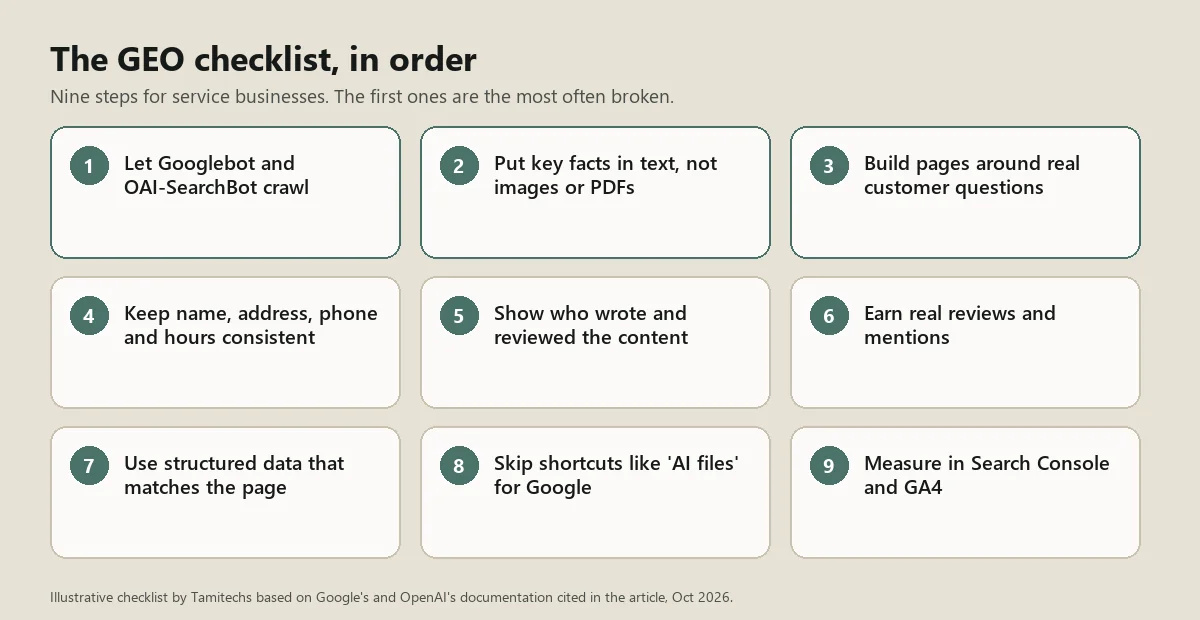
Illustrative checklist by Tamitechs based on Google's and OpenAI's documentation cited in this article (October 2026).
1. Let the right crawlers in
Check your robots.txt and any security or CDN settings. Google lists "ensuring that crawling is allowed in robots.txt, and by any CDN or hosting infrastructure" as a basic for AI features. If you want to appear in ChatGPT search, allow OAI-SearchBot. Changes can take about 24 hours to take effect for OpenAI's systems.
2. Put important information in text
Google advises "making sure that important content is available in textual form." Prices shown only in an image, service areas only on a map widget and hours only in a PDF are hard for any system to read. State them plainly on the page.
3. Build pages around real questions
List the 20 questions your office answers most often on the phone. Each should be answered clearly somewhere on your site, either on a service page or in an article. This is the most direct way to show up when query fan-out searches the subtopics of a customer's question.
4. Make your business facts consistent
Your name, address, phone, service areas, hours and services should match across your website, Google Business Profile, Apple and Bing listings, and industry directories. Google specifically recommends "checking that your Merchant Center and Business Profile information is up-to-date." Our guide to Apple Business and Bing Places covers the listings outside Google.
5. Show who's behind the content
Google's guidance on helpful content asks whether a page presents information "in a way that makes you want to trust it, such as clear sourcing, evidence of the expertise involved, background about the author or the site that publishes it" (Google Search Central). Cite sources, name the people who wrote or reviewed the content, and keep a real About page.
6. Earn third-party mentions
Since AI answers draw on reviews and discussions, a steady flow of genuine reviews and a good reputation in local communities matter. See our guide to reputation management in the age of AI for a plan that stays within Google's and the FTC's rules.
7. Use structured data honestly, but don't expect magic
Structured data still helps search engines understand your pages, but Google says "There's also no special schema.org structured data that you need to add" for AI features, and that your structured data should match the visible text on the page. Our article on schema markup for AI search explains what's worth adding.
8. Skip the shortcuts
Google states: "You don't need to create new machine readable files, AI text files, or markup to appear in these features." Files like llms.txt are harmless, and some other AI tools may read them, but they are not a Google requirement. Spend the time on content and listings instead.
9. Measure what you can
Google says traffic from AI Overviews and AI Mode is included in Search Console's Performance report, under the "Web" search type, and that clicks from results pages with AI Overviews tend to be "higher quality." Visits from ChatGPT and other assistants show up in Google Analytics. Our guide to tracking AI search traffic in GA4 shows how to set that up and tie it to calls and form leads.
A note on AI agents
AI tools are starting to do more than answer questions: they compare options, fill out forms and book appointments for users. The same basics apply. An agent can only recommend or book a business whose services, prices or price ranges, service areas and contact options are clearly stated and easy to act on. A clean, fast website with clear calls to action is as important for an AI agent as for a human visitor.
Where to start this month
If you only have time for three things, do these:
- Check that your robots.txt and hosting settings allow Googlebot and OAI-SearchBot.
- Fix every inconsistency in your business name, address, phone and hours across your website and main listings.
- Write clear answers to your five most common customer questions and add them to the right service pages.
Then ask Google's AI Mode and ChatGPT the questions your customers ask, every month, and note who gets cited. If a competitor keeps getting named instead of you, our diagnostic on why ChatGPT recommends your competitor walks through the usual causes.
From our work
We handle answer engine optimization and AI search presence for several well-known US kitchen appliance brands, alongside Reddit community work. And one San Francisco Bay Area moving company has had us run its online reputation and Google presence, with a partner agency, for 10 years.
Client names are withheld; results reflect each client's own situation and aren't a promise of the same outcome.
Get help with GEO
Our SEO and AI search team runs these checks with service businesses and fixes what's holding them back, and our website development team builds sites that both people and AI tools can read easily. Contact us for a review of how your business shows up in AI answers today.
Sources
- Google Search Central, AI features and your website (last updated December 10, 2025)
- Google Search Central, Creating helpful, reliable, people-first content
- OpenAI, Overview of OpenAI crawlers
- Pew Research Center, Google users are less likely to click on links when an AI summary appears in the results (July 22, 2025)