
Claim Your Business in ChatGPT: How OpenAI's New Business Tool Could Change AI SEO

Until now, AI SEO has worked a lot like the early days of search: you could improve your chances of being recommended, but you couldn't see the results or fix anything at the source. No ChatGPT equivalent of Google Business Profile, no dashboard, no way to correct a wrong phone number except by fixing it everywhere else and waiting.
A test spotted on November 6, 2026 suggests that is about to change. Reports describe a ChatGPT banner reading "Claim your business in ChatGPT," tied to a verified business profile that shows how often a business appears and how often people click (Search Engine Roundtable). If it launches as described, it changes what AI SEO is: from guessing to measuring, and from shaping third-party sources to also owning a first-party one.
One point up front: OpenAI has not announced this feature. Everything about the tool itself comes from reporting on a feature still in testing, and details may change. Below we cover how it could change AI SEO, what has been reported, what OpenAI has confirmed, and the work worth doing now.
How this could change AI SEO
1. From guessing to measuring
Today, the only way to know whether ChatGPT mentions your business is to ask it yourself, and answers differ from person to person. The reported tool counts impressions and clicks and "tracks those events daily and shows them as a chart" (Search Engine Roundtable). That would give AI SEO what Search Console gave traditional SEO: a trend line from the platform itself. You could see whether a new service page, a burst of reviews or a corrected listing moved anything, instead of relying on spot checks.
It won't be a full picture. The report says the tool "does not show prompt data, user data, or any kind of competition benchmark or ranking." You would see that you appeared, not which questions led there or who you were up against. Owners will still need their own tracking, such as AI referrals in Google Analytics (see our GA4 guide for AI search traffic), to connect appearances to leads.
2. A first-party source of truth
ChatGPT search currently draws on "third-party search providers, as well as content provided directly by our partners" (OpenAI). Your business facts reach it secondhand, through your website, listings and directories. The banner's line "keep your business info up to date" points to a verified profile that comes from you directly. If that becomes a trusted input, the claimed profile could become the anchor that other sources are checked against, the way a Google Business Profile is for Google.
That raises the stakes on consistency. A verified profile that says one thing while your website and listings say another doesn't remove the confusion, it adds one more version.
3. A new surface to optimize: your business agent
The banner also promises to "Let your business agent answer their questions with context you control." That is new for AI SEO. Instead of hoping ChatGPT pieces together your pricing policy or service area from scattered pages, you would supply the answers yourself. The quality of that written context, clear, specific and accurate, could matter as much as the website copy behind it.
4. Claiming becomes basic upkeep
For Google, claiming and completing a Business Profile is basic upkeep for any local business. If ChatGPT's tool catches on, the same could happen here, and an unclaimed business could look less complete than a competitor that has verified its details. That is a reasonable expectation, not a confirmed effect: nothing reported says claiming changes how often ChatGPT recommends anyone.
5. What doesn't change
The fundamentals that get businesses recommended today still apply: a website AI crawlers can read, consistent details across listings, clear answers to customer questions, and a steady flow of genuine reviews. A claimed profile measures and corrects; it does not replace any of that. And nothing reported suggests a way to pay for better placement in answers. Treat anyone who promises ChatGPT rankings before OpenAI has even published the rules with caution.
What has been reported
The reports trace back to Juozas Kaziukėnas, founder of Marketplace Pulse, who shared a screenshot of the banner on LinkedIn. Search Engine Roundtable summarized his post the same day. According to that report:
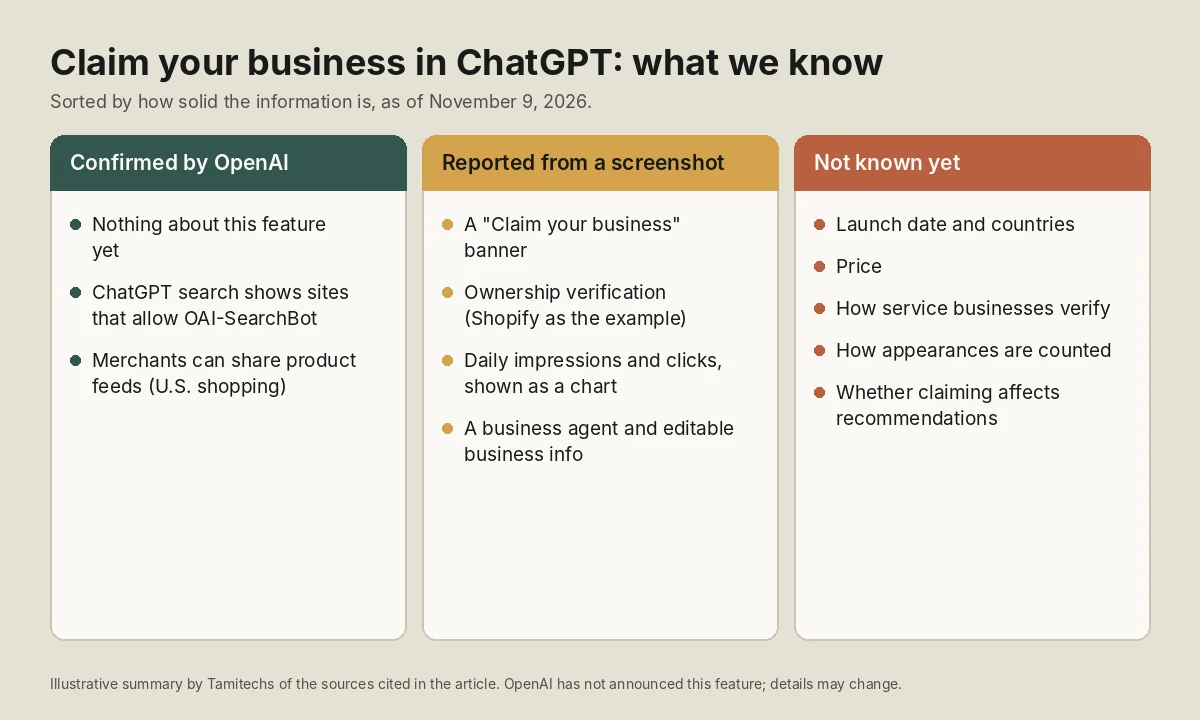
- The banner reads "Claim your business in ChatGPT."
- Its bullet points include "Add your latest products and keep your business info up to date" and "Let your business agent answer their questions with context you control."
- The claim flow is "part of a larger Business Hub feature and only available to business that have verified their ownership."
- The analytics side counts how often a business appears in ChatGPT and how often people click, and "tracks those events daily and shows them as a chart."
- It "does not show prompt data, user data, or any kind of competition benchmark or ranking."
- Kaziukėnas said he saw the feature's "first steps as early as August" and that it "seems to be getting close to launch."
RuntimeWire's report on the same post describes it as a tool that "would let verified businesses track how often they appear in ChatGPT responses," with impressions and clicks shown daily as a chart (RuntimeWire). The one verification method mentioned in the coverage is connecting an existing account, with a Shopify store given as the example (CellCog). That is a single example, not a published list of ways to verify.
What isn't known yet
None of the coverage cites an OpenAI statement, help page or announcement. CellCog, which wrote up the screenshot, puts it plainly: "OpenAI has not announced it, and there is no OpenAI help page for it yet" (CellCog). That leaves several questions every owner will ask:
- When it launches, and whether it starts in the U.S. only.
- Whether it is free, or tied to a paid plan or ChatGPT ads.
- How a service business verifies. A plumber, therapist or moving company has no Shopify store. We don't know what verification will look like for businesses that sell services rather than products.
- What counts as an appearance. A brief mention in a list, a featured card and a cited link to your website may or may not be counted the same way.
- What the "business agent" does, how much you can control what it says, and whether customers will see it.
- Whether claiming changes how often ChatGPT recommends you. Nothing reported so far says it does.
Illustrative summary by Tamitechs of the sources cited in this article, as of November 9, 2026. It will change once OpenAI publishes details.
What OpenAI has said about businesses so far
There are three things OpenAI has published that bear on this.
1. Websites choose whether they appear in ChatGPT search. When OpenAI launched ChatGPT search in October 2024, it said any website or publisher can choose to appear in it, linking to its crawler documentation. It also said ChatGPT search uses "third-party search providers, as well as content provided directly by our partners" (OpenAI). OpenAI's crawler page explains that OAI-SearchBot is the crawler used to surface websites in ChatGPT search, that sites blocking it won't be shown in ChatGPT search answers, and that OpenAI recommends allowing it in robots.txt (OpenAI developer docs).
2. Retailers can already share product data. OpenAI's merchant page invites businesses to "Share your product feed to reach shoppers more effectively as they explore options, compare products, and decide what to buy." It says "Shopping is currently live for ChatGPT users in the U.S.," that Shopify and Etsy catalogs are "already integrated," and that a self-serve merchant platform is being built (ChatGPT Merchants). This is product-focused, which may explain why Shopify is the verification example in the business tool reports.
3. A small-business program, but no listing. On July 21, 2026, OpenAI launched its "ChatGPT for small businesses program," with training, guides and partner tools to help small businesses "be more productive and scale their businesses with ChatGPT" (OpenAI). It is about using ChatGPT inside your business. It says nothing about listings or visibility.
So the reported claim tool would be new ground: the first business-facing profile and analytics for ChatGPT itself.
What to do before it launches
You don't need to wait for the banner to do the work that makes a claimed profile useful. Everything below helps today, in ChatGPT and in every other AI tool.
1. Make sure ChatGPT can read your website
Check your robots.txt file and make sure it does not block OAI-SearchBot. OpenAI says sites that opt out of that crawler won't be shown in ChatGPT search answers (OpenAI developer docs). Some website builders, security plugins and CDN settings block AI crawlers by default, so check rather than assume. If you're not sure how to read the file, your web developer can confirm it in a few minutes. Our website development team checks this on every site we build.
2. Get your business facts consistent everywhere
ChatGPT search pulls from third-party search providers and partners, not a single listing you control (OpenAI). That means your name, phone number, address or service area, hours and services should match on your website, Google Business Profile, Apple Business, Bing Places, Yelp, the BBB and any industry directories. When those sources disagree, AI tools have to guess. We explain how inconsistent details cost local businesses mentions in why ChatGPT recommends your competitor, and cover the listings outside Google in our Apple Business and Bing Places guide.
3. Write down the answers customers want
The reported "business agent" will answer questions "with context you control." Whatever form that takes, you'll need that context written down. Start a simple document now with clear answers to the questions your customers ask most:
- Which services you offer, and which you don't
- Where you work (cities, counties or ZIP codes)
- Hours, including emergency or weekend availability
- How pricing works: free estimates, minimum charges, financing, how quotes are given
- Licenses and insurance, if your trade requires them
- What happens after someone contacts you, and how fast you respond
Put the same answers on your website in plain language. That helps ChatGPT today, and it gives you ready-made material for the business profile if it launches.
4. Keep earning real reviews
AI tools lean on what other people say about you, not only what you say about yourself. A steady flow of recent, detailed reviews from real customers, on Google and the platforms that matter in your industry, is the strongest signal you can build. Ask every customer, never offer rewards for reviews, and reply to them all. Our reputation management service is built around exactly that.
5. Decide who owns the account
When claiming opens, someone has to do it, and it should be an owner or a long-term employee using a business email, not a contractor's personal account. Write down which login you will use for Google Business Profile, Bing Places, Apple Business and, when it arrives, ChatGPT. If the person who set up a profile leaves, getting access back can take weeks.
6. Set a baseline now
Before any official numbers exist, take a snapshot. Ask ChatGPT five or six questions your customers would ask, such as "Who is a reliable roofer in [your city]?" or "Which moving companies in [your area] handle long-distance moves?", and save the answers with the date. Note your AI referral visits in Google Analytics for the past three months. When the dashboard arrives, you'll have something to compare it with. Remember that ChatGPT answers vary between people and over time, so treat this as a rough benchmark, not a ranking.
How we'll handle it
We'll update this article when OpenAI publishes official details. When claiming opens, we'll help clients claim and verify through OpenAI's official flow, keep the details matched to their Google profile, and add ChatGPT's numbers to their monthly reporting.
If you want your website, listings and reviews ready before the banner shows up in your account, our SEO and AI search service covers all of it. Get in touch and we'll show you how your business shows up in ChatGPT today.