
The FTC's Fake-Review and Fake-Listing Case Against a Home Repair Company: What Service Businesses Should Check

On May 11, 2026, the Justice Department, on referral from the Federal Trade Commission, and the State of Illinois sued a Chicago-area home repair company that did business as Premium Home Service, along with its CEO. The case is one of the clearest signals yet that the FTC's rule on consumer reviews is being enforced against local service businesses, not just online sellers (FTC press release, May 11, 2026; Department of Justice press release).
Most plumbers, electricians, HVAC contractors, roofers and movers will never do what this company is accused of. But the complaint describes practices that also show up, in smaller forms, at ordinary businesses: an owner's relatives "helping" with reviews, a marketing vendor that promises a rating boost, or listings at addresses where nobody actually works. This article explains what the government alleges and gives you a practical list of what to check in your own business. It is not legal advice; if you think you have a problem, talk to an attorney.
One important point before we start: a complaint is a set of allegations. The court has not ruled on them, and the company is entitled to contest them.
What the complaint alleges
The complaint was filed in the U.S. District Court for the Northern District of Illinois (case 1:26-cv-05415) against B.E.S.T. GDR, LLC, doing business as Premium Home Service, and its owner (complaint, PDF). It makes two kinds of allegations that matter for marketing.
Fake local businesses. The government says the company created thousands of Google Search and Maps listings for made-up local repair companies. In the complaint's words, "The businesses themselves are not real, and they are not located at the addresses listed in the online profiles." One listed address for a supposed electrical company "is a donut shop," and the company allegedly used "over 7,600 telephone numbers in over 250 area codes" (complaint). The FTC's release says "thousands" of listings; the Justice Department's release puts it at "over 15,000 fake business profiles on Google Search and Maps" (DOJ). Customers who called were allegedly sent to third-party contractors, many of whom, according to the DOJ, "lacked proper qualifications." The complaint says the scheme has run "since at least 2018" and "deceived well over 100,000 consumers."
Fake reviews. The FTC says the company and its CEO "posted fabricated five-star reviews" and used them "to dilute legitimate one-star reviews from actual customers" (FTC). The complaint names who wrote them: "Defendants, their employees or immediate relatives, or other persons acting on their behalf." It says the CEO "and his family have submitted fake reviews," that some reviews used photos taken from unrelated websites with invented reviewer names, and that the company kept buying or writing fake reviews after the FTC began investigating in 2024. It also says the company acknowledged "there were reviews created by some third parties which were not legitimately produced by customers," and that it used outside parties, including SEO providers, to write or change reviews on Google (complaint).
Which rules are involved
The case combines several laws. The complaint cites Section 5 of the FTC Act (deceptive practices), the FTC's Trade Regulation Rule on the Use of Consumer Reviews and Testimonials, the Gramm-Leach-Bliley Act and Illinois consumer protection law (complaint). The Illinois Attorney General is a co-plaintiff.
The reviews rule, which became effective in October 2024 (Venable LLP via Mondaq), is the part most service businesses should know. According to the FTC, the complaint alleges the company broke it "by writing, creating, buying, or selling fake reviews and seeking and using fake reviews from employees and relatives" (FTC). Lawyers at Covington & Burling summarize the rule as prohibiting practices such as writing fake reviews, paying for positive reviews and suppressing negative ones (Covington, Inside Privacy, May 27, 2026).
What makes the rule matter is money. Because it is a trade regulation rule, the government can ask a court for civil penalties, and this complaint does: it seeks civil penalties along with a permanent injunction and money for consumers (DOJ). The Venable write-up describes the rule as a sign that the FTC intends to use that civil penalty authority (Mondaq).
It also isn't a one-off. Covington notes that the FTC sent ten warning letters about possible violations of the rule in December 2025 and reached a settlement under the rule with another company in April 2026 (Covington).
Why this matters even if you run an honest business
Two reasons.
First, the case shows that who writes the review matters, not just whether the job happened. A five-star review from your brother-in-law, your office manager or your nephew is an insider review even if they genuinely like your work. The complaint treats reviews from employees and immediate relatives as part of the problem.
Second, the case shows that "my vendor did it" is not a shield. The complaint describes reviews written by people "acting on their behalf," including outside providers. If an agency, a freelancer or a lead-generation partner posts reviews or creates listings for you, those are still your reviews and your listings in a customer's eyes, and possibly in a regulator's. The Venable authors specifically flag oversight of third-party vendors and lead-generation arrangements as areas to watch (Mondaq).
There is also a business reason that has nothing to do with regulators. When a competitor floods search results with fake listings and fake ratings, the honest businesses lose the calls. That is exactly the harm the FTC describes: fake reviews that "siphon customers from true local businesses," as the subtitle of its release puts it.
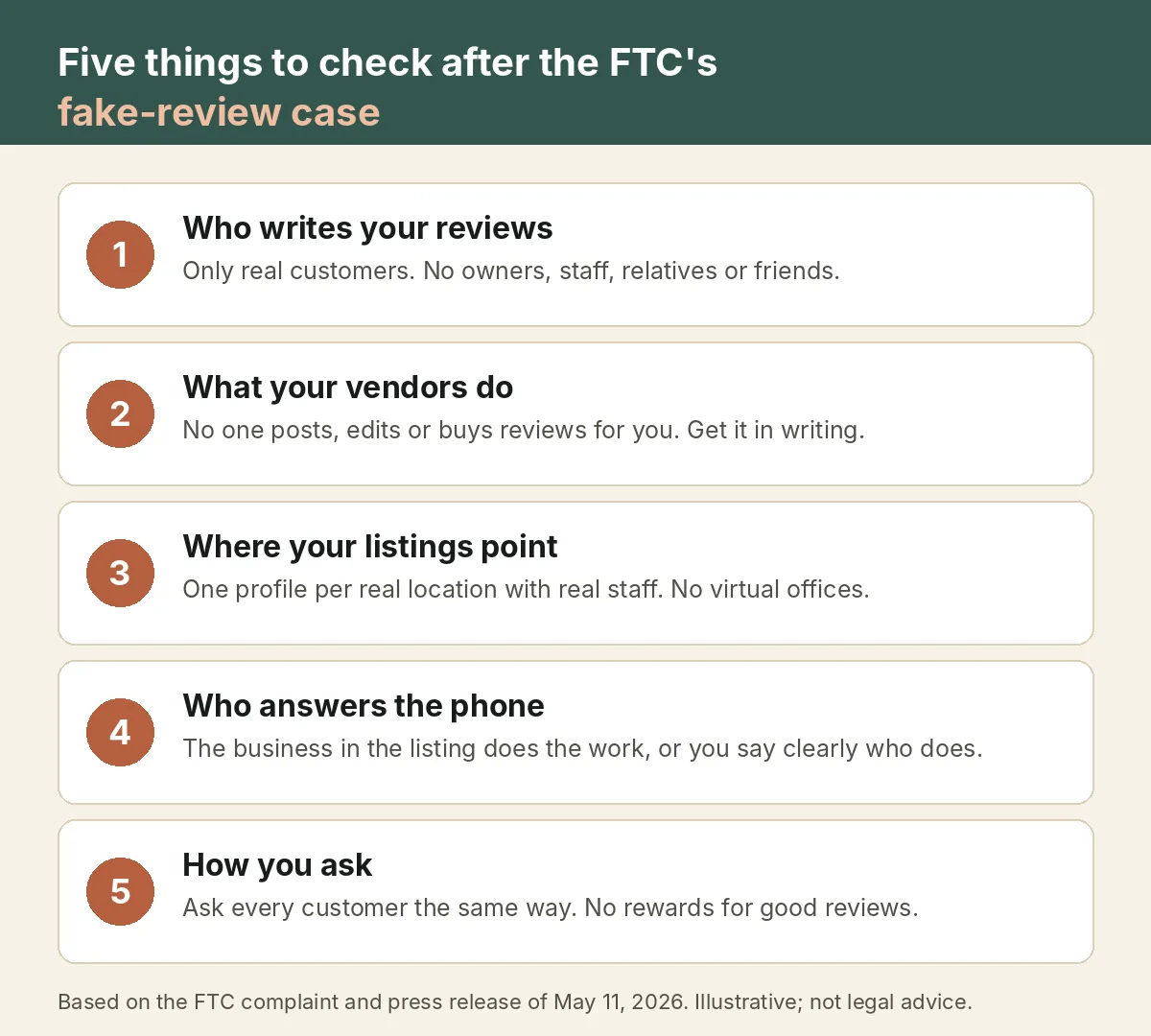
Illustrative checklist by Tamitechs, based on the allegations in the May 11, 2026 complaint and FTC press release cited in this article. Not legal advice.
A checklist for your own business
Use this as a quarterly review. Most items take minutes.
1. Who writes your reviews
- Read your last 50 Google reviews. Do you recognize any reviewer as an employee, a relative, a friend, a former employee or a vendor? If so, ask them to remove it.
- Tell your team in writing that staff and family should not review the business. It's easier to set the rule once than to explain later why a technician's cousin posted five stars.
- If a sudden run of five-star reviews appears that you can't match to real jobs, find out where it came from before it becomes your problem.
2. What your marketing vendors do
- Ask every agency, freelancer and software vendor that touches your reviews or listings one direct question: "Do you post, write, edit or buy reviews for us in any way?" The only acceptable answer is no.
- Put it in the contract: the vendor may help you ask real customers for reviews, but may not create, write, buy or alter reviews, and may not create listings without your approval.
- Be wary of anyone who promises a specific star rating or a number of reviews per month. Real review volume depends on how many customers you serve and how well you ask.
3. Where your listings point
- Search Google Maps for your business name, your phone numbers and your owner's name. Every profile you find should match a real location with real staff, or a real service-area business.
- Don't create extra profiles for virtual offices, mailboxes or addresses where nobody works to "cover" more cities. Use proper service-area pages instead of doorway pages on your website, and set your service area in your one real profile.
- If a former agency set up profiles you didn't ask for, take control of them or have them removed.
4. Who actually does the work
- If you subcontract jobs or buy leads, make sure the customer knows who is coming. The complaint's core allegation is that customers thought they were hiring a nearby, qualified local company and got someone else.
- If you buy leads from a platform, read how that platform presents your business. Your name, license and location should be accurate.
5. How you ask for reviews
- Ask every customer, not only the happy ones, at a consistent moment (for example, after the job is complete and paid).
- Don't offer discounts, gift cards or entries into a drawing in exchange for reviews, and never tie anything to a positive review. Our guide to getting more Google reviews without breaking Google or FTC rules walks through timing and wording.
- Reply to negative reviews calmly and in public. Don't threaten reviewers or try to bury bad reviews under new good ones.
If a competitor is doing this to you
If you see fake listings or fake reviews in your market, you have options that don't involve copying them. Report the profiles and reviews through Google's tools; our guide on how to report fake Google reviews covers the forms and what Google removes. You can also report deceptive business practices to the FTC and to your state attorney general. Keep screenshots with dates, because listings and reviews can disappear once reported.
Then put your effort into what lasts: one accurate Google Business Profile, a steady stream of genuine reviews from real customers, and a website that proves you are a real local business with real people. That is also what AI assistants and Google's AI features draw on when they recommend a provider, as we explain in reputation management in the age of AI.
How we can help
Our reputation management work is built around real customers: we help you ask every customer at the right moment so more of them actually leave a review, respond to reviews, and report fake ones through the proper channels. We don't write, buy or post reviews, and we won't create listings for places where you don't operate. Our local SEO and home services marketing work focuses on making your real business easier to find.
If you'd like a second pair of eyes on your reviews, listings and vendor arrangements, get in touch and we'll walk through the checklist with you.
Sources
- Federal Trade Commission: FTC and Illinois Take Action to Stop Deceptive Conduct by Company that Created Thousands of Business Listings of Fake Local Home Repair Businesses (May 11, 2026)
- U.S. Department of Justice: Department of Justice Files Complaint Against B.E.S.T. GDR, LLC, Doing Business As Premium Home Service (May 11, 2026)
- Complaint, United States and People of the State of Illinois v. B.E.S.T. GDR, LLC, N.D. Ill., No. 1:26-cv-05415 (PDF)
- Covington & Burling, Inside Privacy: FTC and DOJ Continue Focus on Consumer Reviews Rule with Complaint Against Premium Home Service (May 27, 2026)
- Venable LLP via Mondaq: FTC and State AGs Target Reviews and Deceptive Business Listings in Home Services (June 2026)