How Moving Companies Should Respond to Negative Reviews
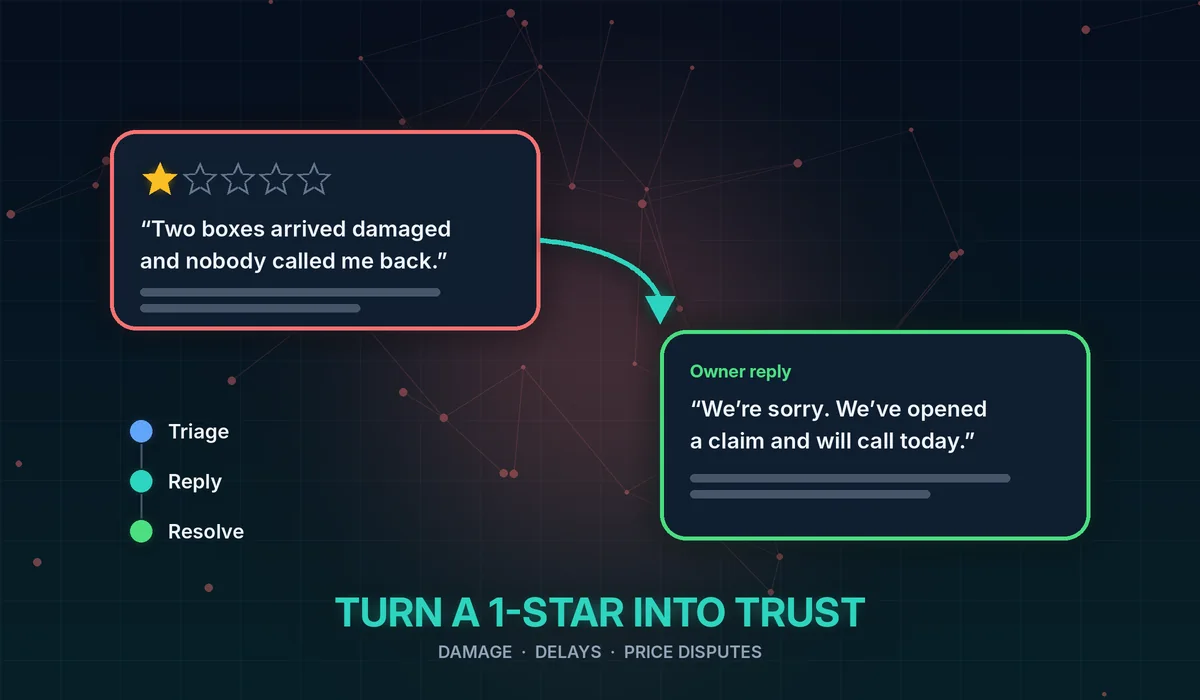
Every moving company gets negative reviews. Furniture gets scratched, trucks get stuck in traffic, and a final bill sometimes comes in above the estimate. What separates strong reputations from weak ones isn't the absence of complaints. It's what the next customer sees when they read the complaint and the reply underneath it.
That next customer is the real audience. The reviewer has already made up their mind, but hundreds of future customers will read your answer. This guide gives you a quick way to decide how to respond, reply examples for the complaints movers get most, and the mistakes that turn one bad review into a bigger problem.
Why the reply matters more than the review
BrightLocal's 2026 Local Consumer Review Survey shows how much customers read into replies:
- 89% of consumers expect business owners to respond to reviews.
- 80% are likely to use a business that responds to all its reviews, and 42% are unlikely to use one that never replies.
- 50% are put off by templated or generic replies.
- 81% expect a reply within a week, and 32% expect one by the next day.
- Replying only to negative reviews makes far fewer consumers likely to use a business than replying to all of them.
Two things follow. First, reply to everything, good and bad, so your negative-review replies don't look like damage control. Second, write each reply for the specific situation, because half your readers can spot a template.
Triage first: three questions before you type
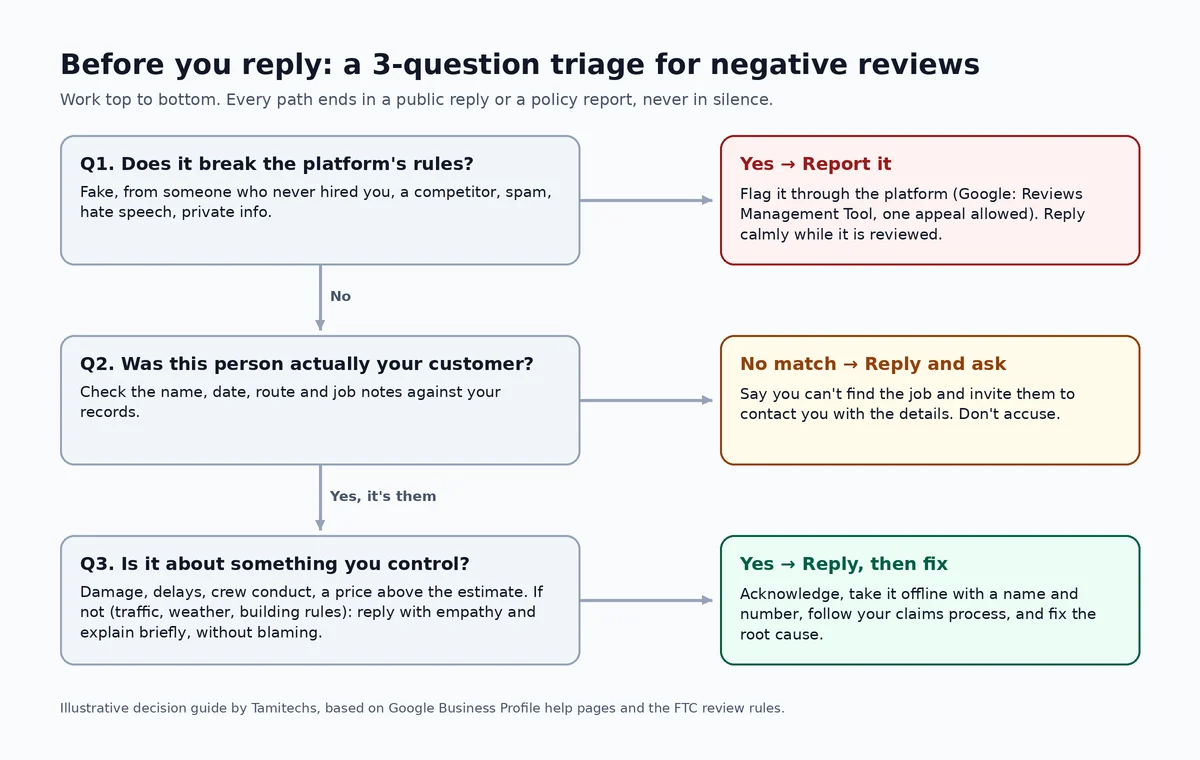
Illustrative decision guide by Tamitechs, based on Google Business Profile help pages and the FTC review rules.
1. Does it break the platform's rules? Fake reviews, reviews from competitors, spam, hate speech, or reviews that expose private information can be reported. On Google, flag them from your Business Profile or the Reviews Management Tool. Evaluation typically takes several days, and you get one appeal if Google finds no violation. Google is explicit that you shouldn't report a review just because you disagree with it (Google: report inappropriate reviews).
2. Was this person actually your customer? Check the name, move date, route and job notes against your records. If you can't find them, don't accuse them of lying in public. Say you can't locate the job and ask them to get in touch with the details.
3. Is the complaint about something you control? Damage, delays caused by your scheduling, crew conduct and billing are yours to own. Traffic, weather, elevator bookings or building rules may not be, but the customer still had a bad day. Reply with empathy, explain briefly, and don't blame anyone.
How to write the reply
Google's own guidance for replying to reviews covers most of what matters (Google: tips for replies):
- Keep it professional, polite, short and relevant.
- Protect the reviewer's privacy. No addresses, inventory details, invoice amounts or claim numbers.
- No personal attacks, even if the review is unfair.
- Acknowledge mistakes without taking blame for things outside your control, and apologize when it's warranted.
- Offer to resolve complicated issues privately by phone or email.
- Sign with your name or initials, and don't use the reply to advertise.
Replies on Google are public, appear as coming from your business, and the reviewer is notified when you reply. They can still update their review afterward (Google: manage customer reviews). That's why a resolved issue often turns into an updated review: the customer sees you followed through.
A simple structure works for almost every negative review:
- Thank and acknowledge, specifically: "Thank you for telling us about the damage to your dining table."
- Own what's yours: "Our crew should have padded it before loading."
- Give a next step with a name: "Our claims manager, Jordan, will call you today. You can also reach Jordan at (555) 555-0100."
- Sign it: "— Sam, Operations Manager."
Reply examples for common moving complaints
These are starting points. Rewrite them in your own words for each review, because generic replies put off half of readers.
Damaged furniture or belongings
Hi Chris, thank you for letting us know about the scratched dresser, and I'm sorry. That isn't the care we promise. Our claims team will contact you today to start your claim and arrange an inspection. If you'd like to reach them first, please call our office and ask for the claims desk. — Sam, Operations Manager
Don't mention the item's value, the claim amount or your liability coverage in public. Those details belong in the claim, not the reply.
Late arrival or a move that ran long
Hi Priya, you planned your day around a 9 a.m. arrival, and our crew arrived after 11. I'm sorry. We overbooked that morning, which is on us, and we've changed how we schedule back-to-back jobs. I'd like to talk through the extra time on your invoice. Please call me directly at the office. — Sam, Operations Manager
Only describe a fix you've actually made. Future customers will check whether later reviews mention the same problem.
Final price higher than the estimate
Hi Marcus, I understand how frustrating a higher final bill is on moving day. I'd like to go through your estimate and final invoice line by line with you, so you can see exactly where the difference came from and we can correct anything that isn't right. Please call me at the office this week. — Sam, Operations Manager
Price disputes can turn into a BBB complaint or, for interstate moves, a complaint through FMCSA's channel. Settle the conversation privately, then post a short follow-up once it's resolved.
Crew conduct
Hi Dana, thank you for raising this. The way our crew spoke to you isn't acceptable, and I'm sorry. I've spoken with the crew lead and we're addressing it directly. I'd also like to hear more about what happened. Please call me at the office. — Sam, Operations Manager
Don't name or discipline employees in public. Say that you've acted, then follow up privately.
Not your customer, or likely fake
Hello, we take every review seriously, but we can't find a move under this name or on this date. If we did work with you, please contact our office with your move date and address so we can look into it. — Sam, Operations Manager
Report it at the same time if it clearly breaks the platform's rules.
What never to do
- Don't threaten legal action to get a review removed. The FTC's 2024 rule bans using unfounded legal threats, physical threats, intimidation or certain false public accusations to prevent or remove negative reviews (FTC: final rule).
- Don't offer refunds, discounts or gifts in exchange for removing or changing a review. Google strictly prohibits it (Google Business Profile Help), and Yelp bans incentives for removing reviews too (Yelp support). Resolve the problem because it's right. If the customer then updates their review on their own, that's their choice.
- Don't rely on contract terms that silence reviews. Under the Consumer Review Fairness Act, form-contract terms that stop customers from reviewing you, penalize them for it, or claim ownership of what they write are void, and the FTC and state attorneys general enforce it.
- Don't argue line by line in public. One reply, a clear next step, then take it offline.
- Don't reply with your team's own reviews. Reviews from employees or relatives are conflicts of interest under Google's policy, and insider reviews are restricted by the FTC rule.
Don't forget BBB complaints
A BBB complaint isn't a review, but it works the same way in public and counts more for your grade. BBB's complaint process gives you 10 calendar days to respond before a second request. Complaints close as resolved, answered or unresolved, and may be published afterward. In BBB's rating formula, unanswered complaints can cost up to 40 of 100 points and unresolved ones up to 30. Apply the same approach: acknowledge, take responsibility for what's yours, and put the resolution in writing.
Turn complaints into fewer complaints
Replies protect today's reputation. Fixing causes protects next quarter's. Once a month, sort your negative reviews and complaints into a few buckets, such as damage, timing, pricing and crew conduct, and pick the largest one to work on:
- Damage: padding and wrapping checklists, and photos of high-value items before loading
- Timing: realistic arrival windows and a text when the crew is on the way
- Pricing: clearer estimates, and written approval before extra charges
- Crew conduct: crew lead training and a customer callback after every job
Your reviews over the following months will show whether the fix worked, and so will the reviews AI assistants summarize when someone asks about you. See How Moving Companies Get Recommended by ChatGPT, Google and Perplexity, and for building a steady flow of new reviews, How to Get More Google Reviews for a Moving Company.
Need help with a difficult review?
Tamitechs helps moving companies triage negative reviews, challenge the ones that break platform rules, draft replies and clear complaint backlogs, confidentially. See our reputation management service, what we do for moving companies, or request a confidential reputation assessment.
Sources
- BrightLocal: Local Consumer Review Survey 2026
- Google Business Profile Help: Tips to get more Google reviews (replying to reviews)
- Google Business Profile Help: Manage customer reviews
- Google Business Profile Help: Report inappropriate reviews
- Google Business Profile Help: Create a review link or QR code
- FTC: Final rule banning fake reviews and testimonials
- FTC: Consumer Review Fairness Act
- Yelp Support: Don't ask for reviews
- BBB: Complaint process
- BBB: Overview of BBB Ratings
Written by Ava Davis for Tamitechs.