Reputation Management for Moving Companies: Google, BBB and Yelp
Few purchases make people as nervous as hiring a mover. A stranger's crew handles everything a family owns, and the final bill can arrive after the truck is already loaded. So before they book, customers go looking for proof that other people trusted you and were glad they did.
That proof lives in a handful of places, and each one works differently. Google shows a star rating and recent reviews. BBB grades you largely on how you handle complaints. Yelp filters reviews it thinks were solicited. Interstate customers are pointed to FMCSA's complaint channel. AI assistants now summarize all of it into a few sentences. Reputation management for a moving company means knowing what counts on each platform, then running a routine that keeps all of them current and accurate.
Why reputation weighs more for movers
The numbers from BrightLocal's 2026 Local Consumer Review Survey explain the stakes:
- 77% of consumers say negative reviews make them less likely to use a business.
- 74% look for reviews written in the last three months, and 32% want reviews from the last two weeks.
- 89% expect business owners to respond to reviews, and 42% are unlikely to use a business that never replies.
- The trust factor consumers rank highest is consistent sentiment across many reviews (56%).
A mover with 200 reviews from 2023 and nothing since looks riskier than one with 60 reviews from this year. A one-star review with no reply looks worse than the same review with a calm, specific answer under it. Most of reputation management is keeping things current, not just keeping the rating high.
Where a mover's reputation actually lives
| Platform | What customers see | What you control | Key rule |
|---|---|---|---|
| Google Business Profile | Star rating, review count, recent reviews, your replies, AI review summaries | Replies, reporting policy violations, asking for reviews | No incentives for posting, changing or removing reviews |
| BBB | Letter grade (A+ to F), complaints and how they closed, customer reviews | Complaint responses within 10 days, resolution, accurate business details | Unanswered complaints cost the most points |
| Yelp | Star rating, recommended reviews, your public comments | Public and private replies, the customer experience | Don't ask anyone for Yelp reviews |
| FMCSA (interstate movers) | Registration status; consumers can file complaints | Accurate registration, a working claims process | Complaints go to FMCSA's complaint database and hotline |
| AI assistants | A short summary of what all of the above says | Consistency across every source | Summaries reflect the sources; there is nothing to "submit" |
Google: the platform most customers check first
Google is still the biggest review source. BrightLocal found 71% of consumers use it to read reviews, even though that share is down from 83% a year earlier. Three habits matter most.
Reply to every review. Google's own guidance is to keep replies professional, short and relevant, avoid sending everyone the same thank-you, protect the reviewer's privacy and respond in a timely manner. Replies are public, appear under the review as coming from your business, and the reviewer is notified. They can still update their review afterward, for example once a complaint is resolved (Google: manage customer reviews). For reply examples by complaint type, see How Moving Companies Should Respond to Negative Reviews.
Report only real policy violations. Google removes reviews that break its rules, such as fake reviews, spam, conflicts of interest or posts from people who were never customers. It says plainly not to report a review just because you dislike it. You flag reviews from your Business Profile or the Reviews Management Tool. Evaluation typically takes several days, and if Google finds no violation you get one appeal (Google: report inappropriate reviews).
Ask every customer, with no strings attached. Google lets you share a review link or QR code after a job. It strictly prohibits offering free or discounted goods or services in exchange for posting, changing or removing reviews (Google: review link and QR code). Its contribution policy also bars selectively asking only happy customers, discouraging negative reviews, setting staff quotas and asking for specific content (Google Maps contribution policy). Our guide to getting more Google reviews within the rules covers the full process.
BBB: your grade is mostly about complaints
BBB is a smaller review source than Google: BrightLocal found 16% of consumers had written a BBB review, against 45% for Google. It still matters because BBB publishes a letter grade for your business, and customers who check it see how you handled every complaint. The important thing to know is that BBB's letter grade is built mainly from how you handle complaints, not from star reviews. According to BBB's ratings overview, customer reviews are not used in the letter grade at all.
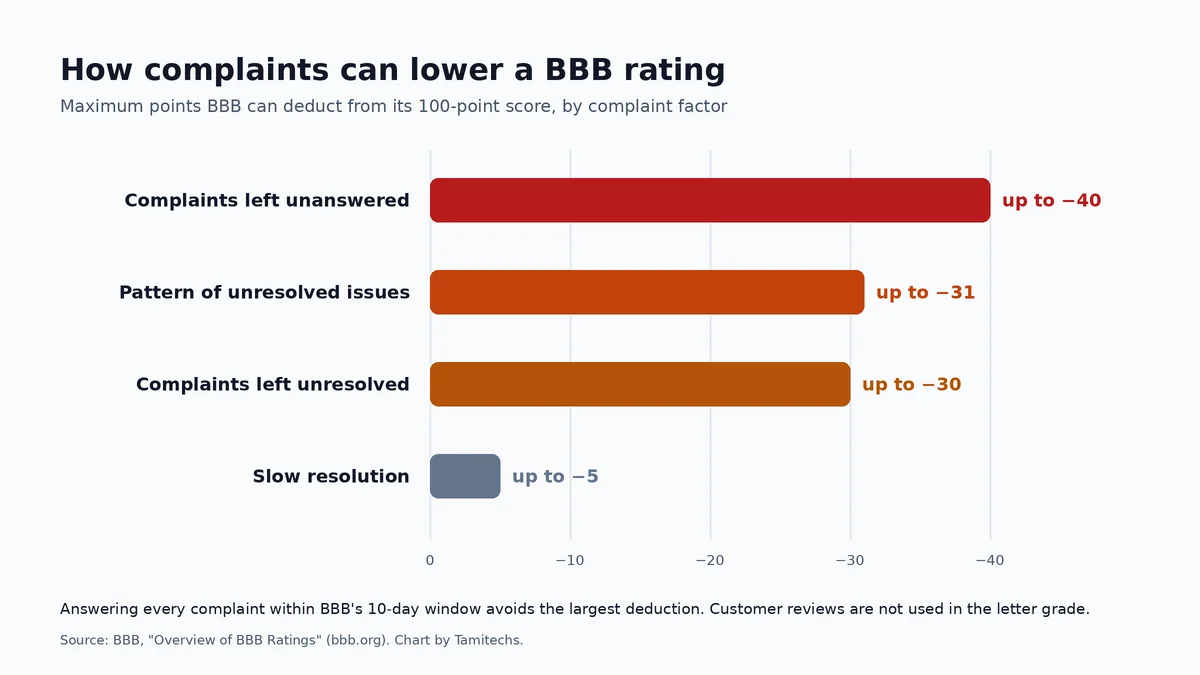
Maximum deductions from BBB's 100-point rating formula. Source: BBB ratings overview; chart by Tamitechs.
The complaint process runs on a clock. BBB's complaint process gives a business 10 calendar days to respond before a second request goes out. The customer then has 6 days to reply to your response, and BBB may ask for a second response or offer mediation. Complaints close as resolved, answered or unresolved, and the complaint text may be published on BBB's site once closed.
For a mover, that means:
- Make sure the email address on your BBB profile reaches someone who checks it daily.
- Answer every complaint, even ones you think are unfair. An unanswered complaint can cost up to 40 points, more than any other factor.
- Make a real attempt to resolve it, and say what you offered in writing. "Unresolved" means BBB saw no good-faith effort.
- Look for patterns. Three complaints about the same thing, such as final bills above the estimate, can cost up to 31 points on their own.
Yelp: don't ask, just earn
Yelp is the exception to "ask every customer." Yelp's support page says not to ask anyone for reviews, including customers, friends and family. Its software may not recommend reviews that look prompted by the business, so asking can actually hurt your rating. It also bans freebies, discounts or payment for reviews and incentives for removing them (Yelp: don't ask for reviews).
So on Yelp, reputation management means two things: a customer experience good enough that people review you on their own, and a public reply to every review so readers see you take feedback seriously. Keep Yelp out of your review-request emails and texts. If a customer asks where to leave feedback, Google is the safe answer.
FMCSA: the complaint channel interstate customers are told about
If you move household goods across state lines, your customers are directed to FMCSA's Protect Your Move resources. They can file complaints against movers and brokers through the National Consumer Complaint Database or the 1-888-368-7238 hotline. Before booking, consumers are told to check the registered mover database (FMCSA: Protect Your Move).
You can't reply to an FMCSA complaint the way you reply to a review. What you can do is keep your registration details exactly right, publish your USDOT and MC numbers on your website so they match the database, and run a written claims process that resolves damage and billing disputes before they escalate.
AI summaries pull it all together
AI-generated review summaries are now common, and AI assistants summarize a company's reputation when someone asks whether a mover is reliable. BrightLocal found 82% of consumers read AI-generated review summaries, and 23% would rely on them alone to decide.
You can't edit a summary. It reflects the sources. If your Google reviews are recent and replied to, your BBB complaints are closed as resolved, and your website states your credentials clearly, the summary has good material to work with. If one platform tells a different story, for example a string of unanswered BBB complaints, that is what tends to show up. We cover how AI tools choose movers in How Moving Companies Get Recommended by ChatGPT, Google and Perplexity.
What not to do
Some reputation tactics create bigger problems than the reviews they're meant to fix:
- Buying or writing reviews. The FTC's 2024 rule bans fake reviews and testimonials, and buying or spreading them when you knew or should have known they were fake. It also bans incentives conditioned on positive or negative sentiment, and the FTC can seek civil penalties (FTC: final rule on fake reviews).
- Threatening reviewers. The same rule bans unfounded legal threats, intimidation and certain false accusations used to get negative reviews removed.
- Gag clauses in your contract. The Consumer Review Fairness Act makes form-contract terms void if they stop customers from reviewing you, fine them for reviewing, or take ownership of what they write. Check your bill of lading terms and website terms of service.
- Reviews from your own team. Google treats reviews from employees and relatives as a conflict of interest, and the FTC rule restricts insider reviews.
A 30-day reputation plan for movers
Week 1: take stock.
- Pull your current rating, review count and the date of your most recent review on Google, BBB and Yelp.
- List every unanswered review and every open BBB complaint.
- Confirm the email on your BBB profile and Google Business Profile reaches a person.
Week 2: clear the backlog.
- Reply to every unanswered review from the last 12 months, newest first.
- Respond to every open BBB complaint with what you'll do and by when.
- Report reviews that clearly break Google's rules, and only those.
Week 3: start the steady flow.
- Create your Google review link and QR code.
- Send one review request to every customer after every completed job, plus one reminder.
- Check your contracts and website terms for anything that limits reviews.
Week 4: fix the causes.
- Group the complaints you received this year by cause: damage, delays, price changes, crew conduct.
- Fix the biggest one in your process, whether that's estimates, scheduling or crew training.
- Set a weekly 30-minute slot for replies and complaints so the backlog never comes back.
Reputation is mostly operations made visible. The companies with the strongest profiles aren't the ones with clever replies. They're the ones whose fixes show up in the next month's reviews.
Get a reputation assessment for your moving company
Tamitechs helps moving companies take stock of their reputation across Google, BBB, Yelp and AI search, clear complaint backlogs and build a steady flow of genuine reviews. See our reputation management service, what we do for moving companies, or request a confidential reputation assessment.
Sources
- BrightLocal: Local Consumer Review Survey 2026
- Google Business Profile Help: Manage customer reviews
- Google Business Profile Help: Tips to get more Google reviews
- Google Business Profile Help: Report inappropriate reviews
- Google Business Profile Help: Create a review link or QR code
- Google Maps: Prohibited and restricted content
- BBB: Overview of BBB Ratings
- BBB: Complaint process
- Yelp Support: Don't ask for reviews
- FMCSA: How to file a complaint against a household goods mover or broker
- FTC: Final rule banning fake reviews and testimonials
- FTC: Consumer Review Fairness Act
Written by Ava Davis for Tamitechs.